

How Much to Allocate When Diversifying Investments With Fine Art
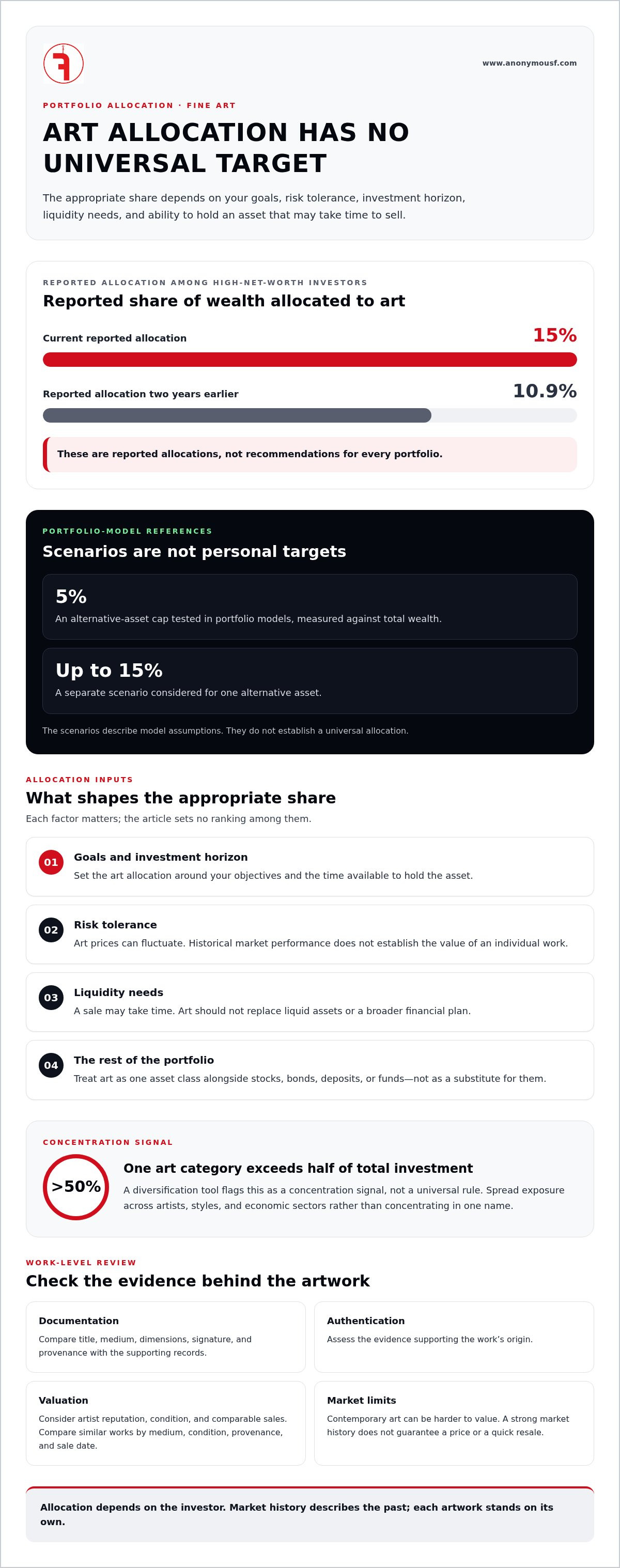
There is no universal allocation for diversifying investments with fine art; the appropriate share depends on your goals, risk tolerance, time horizon, and ability to hold an asset that can be difficult to sell quickly. High-net-worth investors allocate 15% of their wealth to art, compared with 10.9% two years earlier. That is a reported allocation, not a recommendation for every portfolio.
Art’s price history can make the market look steadier than it is. A rising record does not establish that every artist, or every work by that artist, is investment-grade.
This article explains how to assess an artist’s market standing, consider an allocation alongside other assets, and account for transaction, storage, and insurance costs. It also looks at what art’s investment history can show and where its limits matter: value is subjective, and a sale may take time.
Key Takeaways
- Set an art budget around your goals, risk tolerance, and investment horizon, and avoid concentrating a collection in one artist or style.
- Assess an artist’s reputation alongside a work’s authenticity, provenance, and resale liquidity; strong market history alone doesn’t establish value.
- Account for commissions, insurance, and suitable storage when estimating the full cost of owning art.
- Treat historical indexes as context, not a forecast for an individual artwork; Fringe’s collectable toys are one physical collectible category to consider separately from its paintings, prints, and sculptures.
Analyzing investment amounts and portfolio distribution
Art can diversify a portfolio, but it should not replace stocks, bonds, deposits, or funds. Its low correlation with traditional markets may reduce portfolio variance for a given target return. However, art can be difficult to sell quickly. Treat it as one asset class within a broader strategy, not as a substitute for liquid assets or a financial plan.
High-net-worth individuals allocate 15% of their wealth to art, compared with 10.9% two years earlier. These figures describe reported allocations, not a target for every investor. Portfolio models have tested alternative-asset caps of 5% of total wealth, while another scenario considered up to 15% for one alternative asset. The appropriate allocation depends on investment horizon, risk tolerance, liquidity needs, and overall goals.
Spread exposure across artists, styles, and economic sectors rather than concentrating the collection in one name. A diversification tool flags portfolios where one art category exceeds 50% of total investment. That threshold is a concentration signal, not a universal rule. An advisor can weigh artist reputation, market trends, and how each work represents a distinct category or period.
For U.S. tax planning, consider potential tax on a sale when estimating net returns. Keep records of acquisition and sale details; tax treatment depends on the transaction and the investor’s circumstances.
Before buying, compare the artwork’s title, medium, dimensions, signature, and provenance with its documentation. Authentication depends on evidence supporting the work’s origin. To assess value, consider the artist’s reputation, the work’s condition, and comparable sales. Contemporary art can be harder to value than established works, so a market history alone is no guarantee of price.
Art-market transaction, storage, and insurance costs
The purchase price is only part of an artwork’s investment cost. Auction buyers may pay a buyer’s premium, while commissions, insurance, and storage add further expenses. The study’s art index excludes the buyer’s premium, so its reported returns do not reflect that transaction cost. Fine art also needs proper care and climate control, and standard homeowners’ or renters’ insurance often provides limited artwork coverage.
Collectors can buy through auctions or galleries, or gain pooled exposure through art funds. These funds pool investors’ resources to acquire works and may manage acquisition, storage, and insurance. Some acquire works at primary-market prices to avoid auction markups. Shares in art-related companies and art ETFs provide art-market exposure without owning physical artwork. Each route differs in ownership, liquidity, and costs; pooled funds are not the same as selecting an individual work.
Art can have low correlation with traditional markets, but that does not eliminate price volatility. A buyer may have to wait for someone willing to pay the desired price, so liquidity is limited. Artist reputation, changing tastes, and demand can all affect resale prospects. An investment portfolio should account for these risks alongside transaction and holding costs.
To research an artist, compare documented sales of similar works, noting medium, condition, provenance, and sale date. Track auction results over time rather than treating one record as a trend. The study found art returns peak in May and November, when prestigious works are sold. That seasonality describes an index pattern, not a reliable selling date for every artwork.
Art investment history and track record
Art’s historical record depends on what the index measures. The Artprice 100 Index rose nearly 400% over 20 years, but an index’s movement doesn’t describe every artist or artwork. Global art sales revenue reached $13.3 billion in 2019, up from $3.2 billion in 2000. Sales revenue measures market activity, not investor returns or the change in value of one work.
Longer datasets offer context, not a promise. One study analyzed a US-dollar-denominated, US-inflation-adjusted art index from January 1978 to December 2022. Its AMRAAI data is available monthly beginning in January 1978, while the study built a separate semi-annual index using May and November values. Index construction matters: the results depend on which artworks and sales enter the series.
Individual records show why averages can mislead. Those sales document one painting’s market history, not a return available to every owner. Artists differ, and an artwork’s provenance, condition, and demand shape its valuation.
Use historical figures to frame art as an alternative asset, not as a substitute for securities or a forecast of future capital growth. Physical ownership also differs from owning a financial instrument: personal taste may influence a purchase, while resale depends on finding a buyer. Compare the index’s period and method with the individual work’s documented sales. The distinction is clear: market history describes the past; each artwork stands on its own.
Fringe: Collectable Toys
Fringe creates physical, three-dimensional collectable toys featuring original characters Mylo, Nova, and Gutinke. These characters also appear across a wider body of pop art.
Fringe also offers bronze sculptures, oil on canvas, and limited edition prints. Its collectable toys are character-based artworks, distinct from these formats.
Each toy is part of Fringe’s physical art practice, with the character at its heart.
Set a Clear Intent for Your Next Acquisition
Before adding an artwork, define its intended role in your financial plan. Diversifying investments with fine art means distinguishing personal ownership from expected financial performance. An artwork’s appeal and its resale value are separate considerations.
Fringe offers collectable toys, bronze sculptures, and oil on canvas, each a distinct form of art ownership. A work’s market value depends on the individual artwork, not the category alone.
Art-market history provides context, while the evidence for an individual work determines its own case. Any allocation belongs within a broader financial plan.
Frequently Asked Questions
What’s an Investment-Grade Artist?
An investment-grade artist generally has an established market and sustained collector demand, not simply a high asking price. For collectors diversifying investments with fine art, assess comparable completed sales, the artist’s reputation, and whether prices hold across different works and periods. Provenance, authenticity, condition, and documentation also affect an artwork’s standing. No label guarantees future value.
How can fine art diversify an investment portfolio?
Fine art can add exposure to an asset with low correlation to traditional markets. A study found that including art can reduce portfolio variance for a given target return. For someone diversifying investments with fine art, the effect depends on the allocation and the other assets held. Compare art exposure with stocks and bonds while keeping liquid assets available for near-term needs.
What percentage of a portfolio should be allocated to art?
There’s no universal target for diversifying investments with fine art. High-net-worth investors allocate 15% of their wealth to art, but that reported figure isn’t a recommendation for every investor. Set an allocation based on your investment horizon, liquidity needs, risk tolerance, and overall goals. A smaller share can still add exposure, while a larger one increases art-market effects on total wealth.
What are the historical returns and volatility of fine art investments?
Historical results vary by category and measurement period. Blue-chip art grew by 12.6% annually over the past 25 years, while contemporary art delivered real returns over 23% annually during inflation-heavy times. These figures describe specific segments and conditions, not every artwork. Art also held its value during downturns in 2008 and 2018, but an individual work can behave differently.
How do fine art returns compare with stocks, bonds, and real estate?
Art does not have a single directly comparable return figure to stocks, bonds, and real estate; results depend on the index, period, and costs measured. Its low correlation with traditional markets can offer a different return pattern, but ownership is less liquid than traded securities. Compare performance over matching periods, account for art-market costs, and distinguish index results from individual artwork outcomes.

Article by
Fringe

Read more
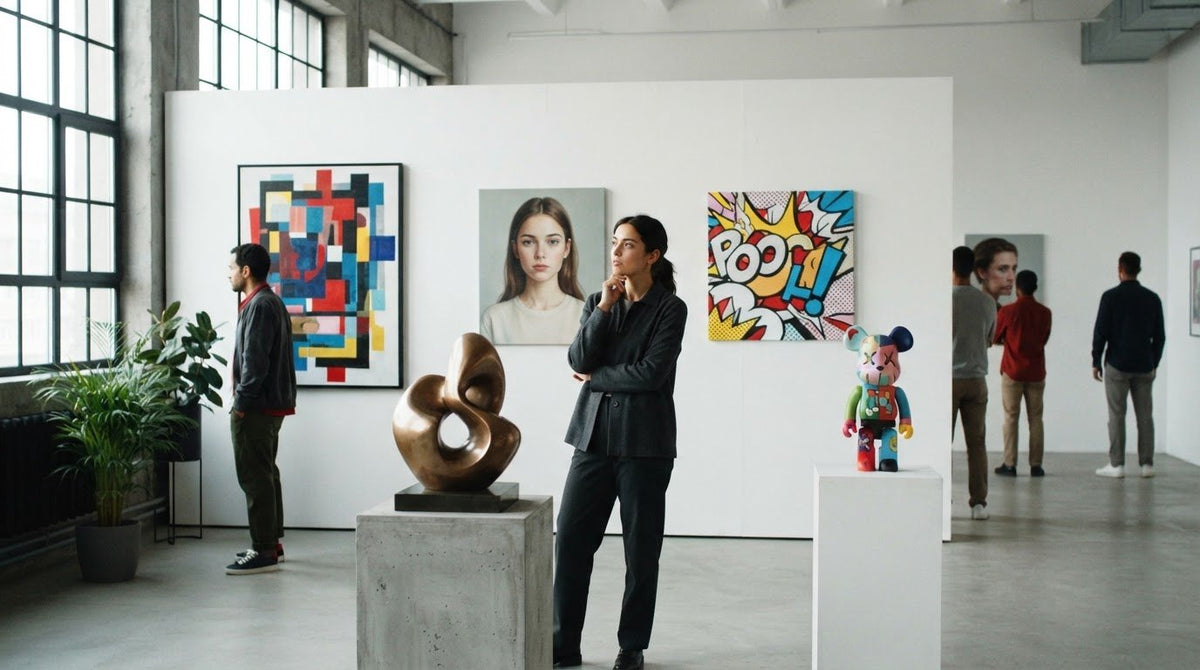
Finding Art That Reflects Your Personality and Artistic Taste
Your art preferences can offer clues about your personality, but they don’t define it. Openness to experience is often associated with abstract and other non-traditional art, while people drawn to ...
Read more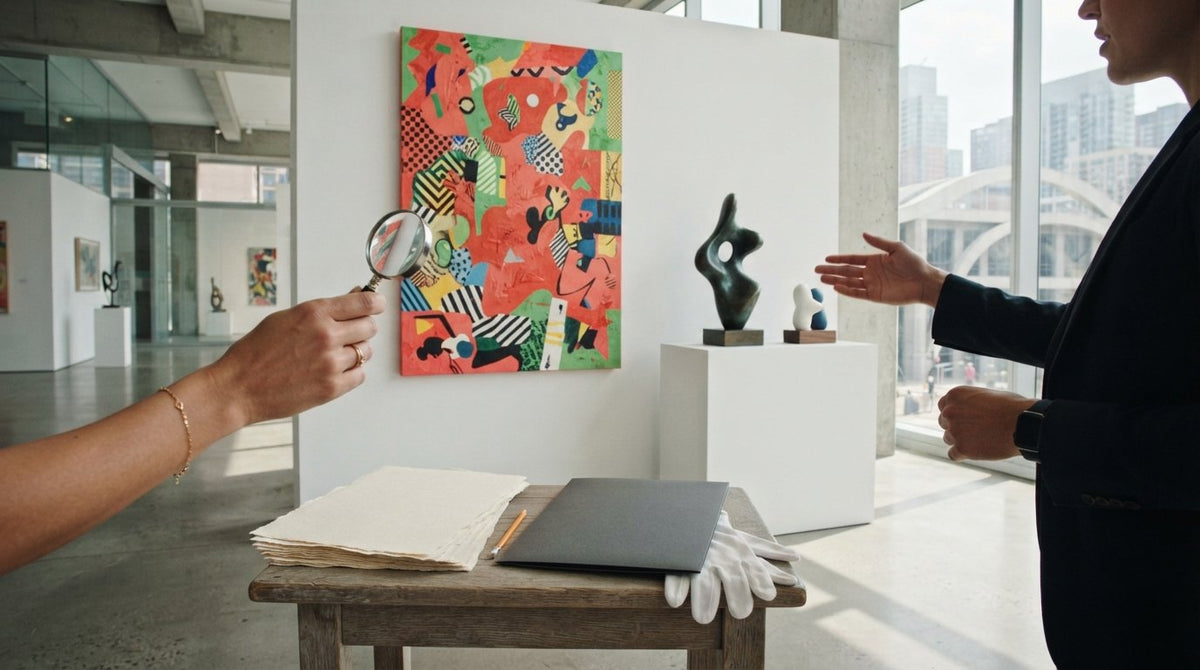
How to Buy Art With Confidence and Choose What You Love
Original art is made by an artist, while a reproduction copies an existing work. A limited-edition print should be identified by its edition details, not simply by the word “print.” To learn how to...
Read more
Leave a comment
This site is protected by hCaptcha and the hCaptcha Privacy Policy and Terms of Service apply.