

Finding Art That Reflects Your Personality and Artistic Taste
Your art preferences can offer clues about your personality, but they don’t define it. Openness to experience is often associated with abstract and other non-traditional art, while people drawn to figurative work may value clarity, order, and structure. Finding art that reflects your personality means noticing these patterns without treating them as rules.
A style that feels right can reflect more than a personality trait. Colour, subject, mood, and openness to interpretation all shape your response. This article explores how personality traits can influence art preferences, then connects those patterns to realism, abstraction, and pop art. The practical aim is to help you identify what holds your attention and why certain works feel like yours.
Key Takeaways
- Openness to experience is often associated with abstract and non-traditional art, while representational work can appeal to people who value clarity and structure.
- Personality traits suggest possible preferences, not fixed rules; your response to a work matters more than a label.
- Compare the subjects, colours, and degree of ambiguity that hold your attention to identify patterns in your taste.
- Fringe offers collectable toys, bronze sculptures, oil on canvas, and limited edition prints in distinct forms and mediums.
Art preferences associated with openness to experience
Openness to experience describes a tendency toward imagination and intellectual curiosity. It often aligns with abstract art, cubism, and other non-traditional forms, where interpretation remains open. If you appreciate a painting that raises questions rather than settling on one meaning, that response may reflect this trait. These are patterns, not personality tests.
Conscientiousness is associated with organization and goal-setting. People with this trait may prefer simple, representational pieces over ambiguous or complex compositions. Agreeableness, linked with friendliness and cooperation, can accompany varied preferences, from serene landscapes and religious art to depictions of violence. Extraverts are often sociable and expressive; they may be drawn to vibrant abstract art, impressionism, Japanese art, or classical painting.
When finding art that reflects your personality as a couple, each partner can name a few works they respond to, then compare their subjects, colours, and moods. You might share a preference for nature imagery, while differences in style can still work together through a repeated colour or theme. The overlap matters more than matching every choice.
Original art generally costs more than prints or posters, but prices vary by artist, medium, scale, and provenance. Compare works in the same format and by artists at similar career stages rather than treating every original or print as equivalent.
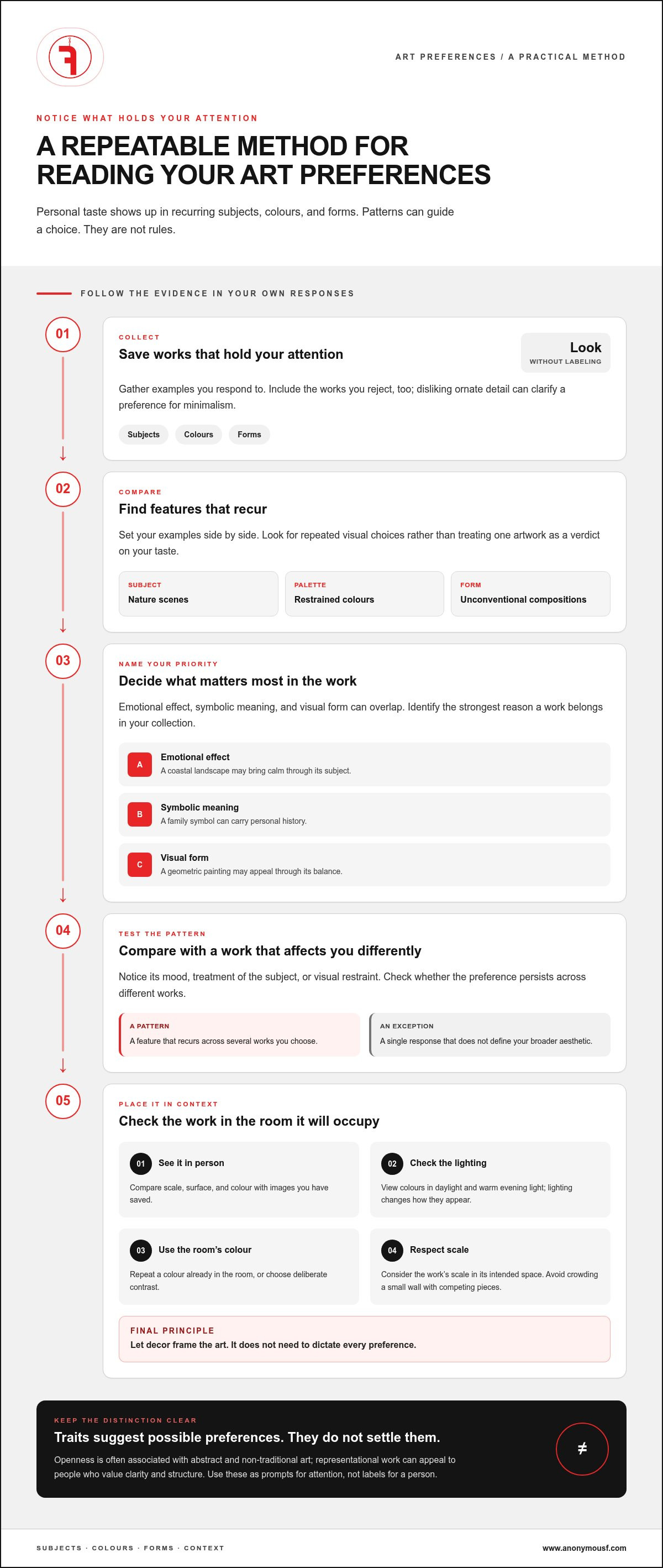
To match art with your home decor, identify a colour already in the room, then choose a work that repeats it or provides deliberate contrast. View the colours in daylight and warm evening light, since lighting changes how they appear.
Avoid choosing art solely to match the sofa, overlooking the room’s lighting, or crowding a small wall with competing pieces. Before deciding, consider the work’s emotional effect and scale in its intended space. Decor should frame the art, not dictate every preference.
Art styles and personality traits
Neuroticism is one of the Big Five traits, alongside openness, conscientiousness, extraversion, and agreeableness. It describes a tendency toward emotional instability and anxiety. Some reported preferences associated with neurotic traits include romantic art, unpretentious styles, and sad paintings with dark, cold palettes. These are tendencies, not a reliable way to infer someone’s character from a single artwork.
Colour and emotional subject matter are separate considerations. Available findings associate neurotic traits with certain kinds of paintings, but not with colour choices themselves. A dark palette, for example, may appeal because of a work’s composition or atmosphere rather than the viewer’s personality. This distinction matters when reflecting on your response: liking one sad painting doesn’t define your broader aesthetic.
Use personality frameworks as prompts for closer attention, not as labels. When a work stays with you, identify what held your focus: its emotional register, treatment of a subject, or visual restraint. Compare that response with a work that affects you differently. The contrast can reveal whether you consistently value a style or respond to a particular mood. Personal taste has room for both patterns and exceptions.
Neurotic traits have no effect on color choices, so a viewer’s response to a palette should not be treated as evidence of that trait. Instead, notice what the colors do within the work: reinforce its mood, create contrast, or draw attention to a particular area. These observations describe your experience without turning one preference into a personality judgment.
Extraversion describes a tendency to be sociable, assertive, and emotionally expressive. It can be a prompt for reflection, but it does not determine which art styles someone will prefer. Consider whether a work invites an outward, expressive response or a quieter one, then notice whether that reaction persists across different works. The aim is to describe your experience of art, not assign a trait based on it.
Artistic styles and personality
Artistic choices reflect what you notice, value, and want in your daily life. Landscapes, minimalist compositions, and vivid colours each create a different relationship with a room.
Choosing Between Emotion, Symbolism, and Visual Style
Choosing art means deciding whether emotional effect, symbolic meaning, or visual form matters most. Naming your priority can help explain why a work belongs in your collection. A coastal landscape might bring calm through its subject, while a family symbol carries personal history. A geometric painting may appeal through its balance, even without a personal story. These priorities can overlap, but identifying the strongest one makes choices more deliberate.
Identifying Personal Style and Aesthetic Preferences
Your personal style emerges in the subjects, colours, and forms you repeatedly choose. To identify it, save examples of artwork that holds your attention, then compare their shared features. You might notice recurring nature scenes, restrained palettes, or unconventional compositions. Include works you reject, too: disliking ornate detail can clarify a minimalist preference. Your aesthetic can be diverse and may change as your experiences and values shift.
To explore art in person, look for open-studio events, community exhibitions, and gallery programs. Seeing work up close lets you compare its scale, surface, and colour with images in your collection. Choose by the feature that matters most, then let emotion, symbolism, and visual style refine your decision.
Create a visual inventory of the imagery, colours, and design elements that attract you to help guide your art choices. Build a gallery wall around an anchor piece that strongly represents your style.
If you lead a hectic lifestyle, calming artwork with serene imagery or soft colours may help create a more relaxing home environment. Coastal scenes or gentle abstracts, for instance, can offer a soothing visual presence. If you enjoy spending time at home, cozy, inviting art can make a space feel warm and welcoming. If heritage matters to you, folk art or traditional patterns can reflect that connection.
Fringe: Collectable Toys
Fringe creates collectable toys featuring original characters, including Mylo, Nova, and Gutinke. Its physical artworks also include bronze sculptures, oil on canvas, and limited edition prints.
Each format presents an artistic point of view differently. Collectable toys put character at the centre, while bronze sculptures use three-dimensional form. Oil paintings and prints present images on a surface. Each offers a distinct way to connect with a work.
Let Your Next Choice Be Personal
Finding art that reflects your personality is less about choosing a label and more about noticing what continues to hold your attention. Let your next choice follow a subject, mood, or form that feels specific to you. Preferences can shift as your experiences and surroundings change.
Before choosing, consider what you want to notice each day and which details keep drawing your eye. A collection can hold contrasting moods without needing a single label. Your taste is allowed to change with you.
Frequently Asked Questions
What types of art reflect different personality traits and values?
Art can reflect values through its subject, visual language, and cultural references. Realist works with precise detail may appeal to people who value clarity and authenticity. Folk art and traditional patterns can connect with heritage, while nature imagery may suit people who value calm or sustainability. Treat these associations as prompts for choosing, not fixed descriptions of character.
What questions should I ask myself before buying art?
Ask what you want the work to contribute and whether its meaning will last beyond a passing mood. Consider whether you respond to its subject, technique, or story, and whether you would still value it if visitors made no comments. Then think about where it will be displayed and whether the room gives it enough visual space.
Where can I find affordable art that feels personal and unique?
Consider open-edition prints, emerging artists, print-on-demand services, or vintage reproductions. To make a choice feel personal, look for subjects, colours, or design elements that consistently attract you.

Article by
Fringe

Read more

Artist Studio Visit: What to Expect Before and After
A studio visit is a meeting between an artist and a guest in the artist’s workspace. If you’re wondering what to expect from an artist studio visit, expect to discuss selected work, current project...
Read more
How Much to Allocate When Diversifying Investments With Fine Art
There is no universal allocation for diversifying investments with fine art; the appropriate share depends on your goals, risk tolerance, time horizon, and ability to hold an asset that can be diff...
Read more
Leave a comment
This site is protected by hCaptcha and the hCaptcha Privacy Policy and Terms of Service apply.