How Limited Edition Toys Are Made: From Design to Finished Edition
Understanding how limited edition toys are made means following the character from concept through design, production, finishing, and the records attached to its release. “Limited” describes a claim about an edition. The production route and the edition terms establish what that claim means.
A mold or model can indicate how an object was produced. It does not, by itself, establish the process used for a particular toy. Edition size, numbering, and provenance answer different questions, and each depends on its own record.
This guide follows the general sequence from design to finished collectible, then explains how materials, production methods, and edition terms affect what a collector can establish. Fringe creates character-based collectible toys featuring original characters including Mylo, Nova, and Gutinke. The character, the physical object, and the release record are distinct parts of the work.
Key Takeaways
- How limited edition toys are made begins with design decisions that carry into the production specification.
- Material, scale, and intended edition influence the production route. Molding and casting are common examples, not universal steps.
- Edition size, individual numbering, and production records describe different things. None alone establishes an object’s value.
- Compare numbered editions, unnumbered runs, and open editions by the terms recorded for each release, not by the word “limited.”
How limited edition toys are made: the idea becomes a production-ready design
An original character design establishes identity. A toy design must also translate that identity into a form that can be made at a chosen scale and in a chosen material. The drawing or concept and the finished object are related, but they are not the same thing.
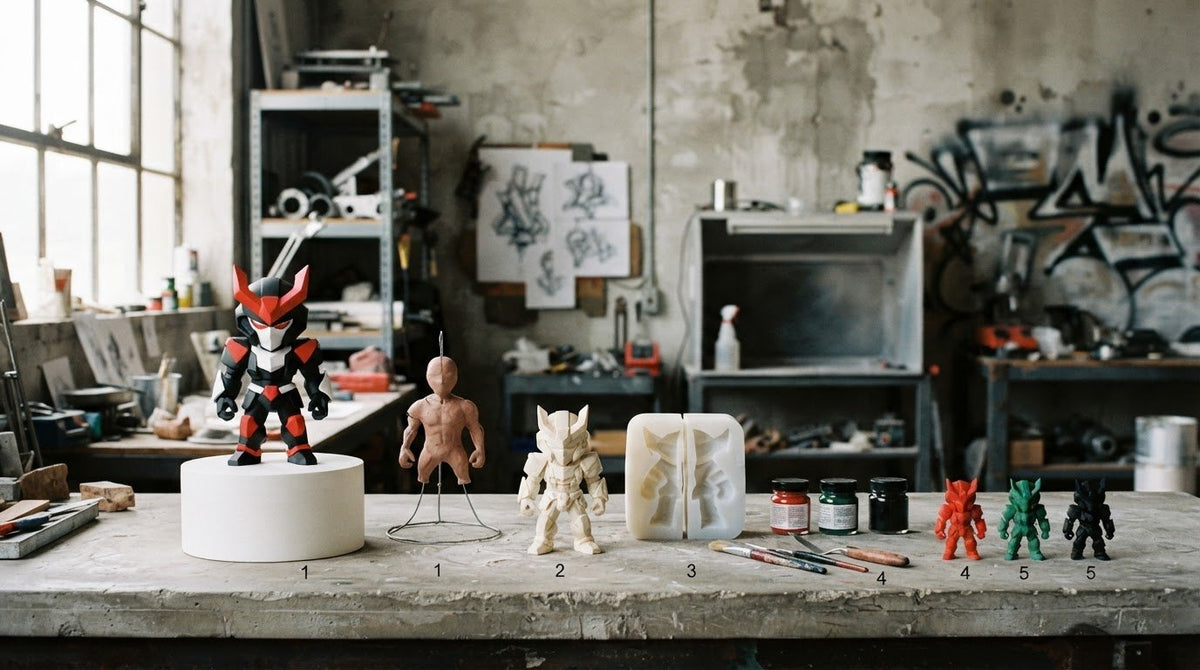
As a general model, how limited edition toys are made can be understood in four stages. The sequence and level of detail vary by project.
- Concept: Define the character’s identifying features and the qualities the finished object needs to retain.
- Design refinement: Resolve silhouette, proportions, expression, and details that must read clearly in three dimensions.
- Prototype: Review a preliminary physical or digital form for scale, shape, and construction.
- Production specification: Record the decisions needed to make the object, including dimensions, materials, finish, and construction approach.
What happens between a toy concept and its prototype?
The silhouette determines how a character reads at a glance. Proportions and facial expression establish its appearance, while construction affects how parts fit together and which details can be reproduced. Reviewing a prototype gives the maker a chance to identify design or fit issues before production decisions are finalized.
Material and manufacturing method depend on the design, scale, and intended edition. Molding and casting are common production examples, but they are not required steps for every toy. The Art toy overview describes designer toys and materials such as vinyl and resin. Neither one defines the whole category.
Fringe creates collectible toys featuring original characters including Mylo, Nova, and Gutinke. The characters give each work its identity. The broader context of collectible designer toys places character-based objects within a wider design category.
How limited edition toys are produced: materials, methods, and finishing
Production routes depend on the design, material, scale, and intended edition. A method suited to a small, detailed run may not suit a larger run. The choice affects how the form is made, assembled, and finished.
How do material and production method affect a collectible toy?
Vinyl toys are commonly made by rotocasting, a method used for hollow forms and larger production runs. Resin casting is often used for smaller, detailed runs. Resin can capture fine sculptural detail, but it is more brittle and labor-intensive to produce. These are general industry examples, not rules for every collectible.
Finishing decisions can include paint colors, surface treatment, and the fit of separate parts. A production plan may also set inspection criteria for visible seams, paint application, or assembly. The relevant checks depend on the object and process. There is no single factory sequence for every collectible toy.
A prototype tests a proposed form; a production object is made as part of the edition.
A prototype can prompt changes to shape, assembly, or finish. It does not establish that every finished object will be identical. The production specification records what the edition is intended to reproduce. How closely individual pieces match depends on the process and the tolerances set for the work.
Appearance alone cannot identify a toy’s production route. Vinyl and resin involve different production considerations, but the surface does not reveal which method made a particular object. A smooth finish, for example, does not establish how it was achieved or what inspection criteria were used.
How limited edition toys get their edition identity and collector record
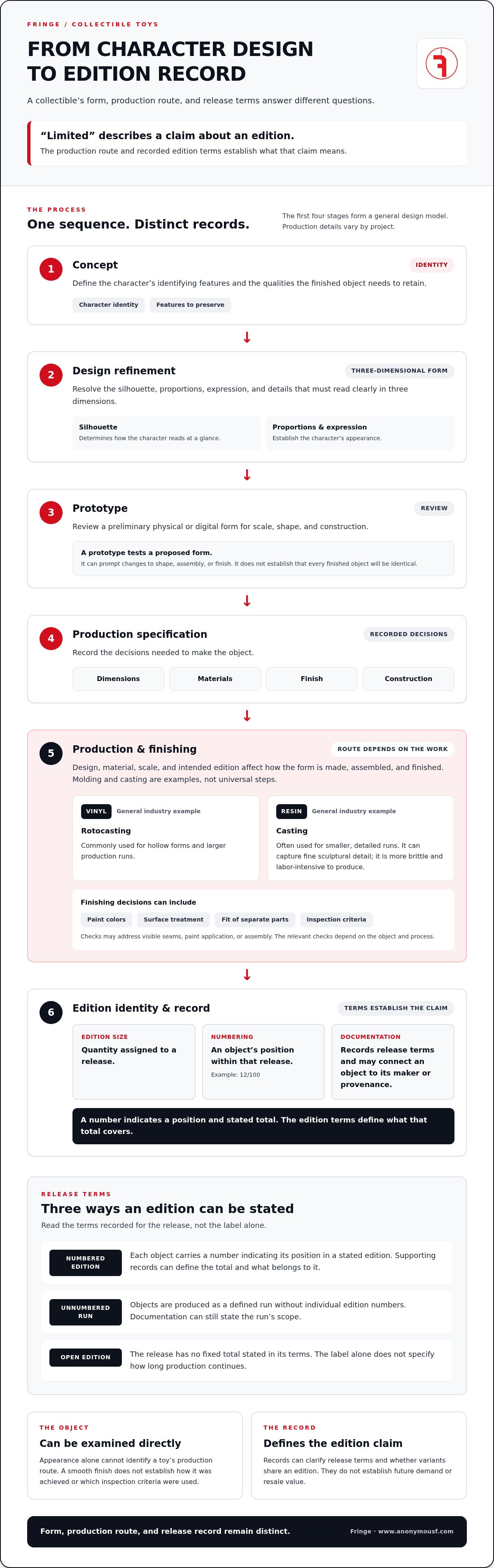
Edition size, numbering, and documentation serve different purposes. Edition size states the quantity assigned to a release. Numbering identifies an object’s position within that release, such as 12/100. Documentation records the release terms and may connect an object to its maker or provenance. None of these details guarantees market value.
An edition claim is clearest when the limit, numbering, and release it describes are recorded.
What should collectors understand about edition size and documentation?
A number printed on a toy is not a complete record. It indicates a position and a stated total, but the edition terms define what that total covers. Those terms can clarify whether variations belong to one release or count as separate releases. Read the terms, not just the label.
- Numbered edition: Each object carries a number indicating its position in a stated edition. Supporting records can define the total and what belongs to it.
- Unnumbered run: Objects are produced as a defined run without individual edition numbers. Documentation can still state the run’s scope.
- Open edition: The release has no fixed total stated in its terms. The label alone does not specify how long production continues.
Records can clarify a maker’s claims, including release terms and whether variants share an edition. They do not establish future demand or resale value. Fringe’s collectible toys feature character-based work, including Mylo, Nova, and Gutinke.
Let the record remain part of the object
A collectible’s identity extends beyond production. The information preserved with it helps establish how its authorship and edition claim can be understood later. For collectors, keeping that record with the object is part of ownership.
When assessing how limited edition toys are made, separate the object from the claims attached to it. The form can be examined directly. An edition statement depends on what the maker has recorded. Clear terms allow the work to be understood without treating rarity as a substitute for artistic identity.
Fringe’s original character-based collectible toys include Mylo, Nova, and Gutinke. Each character has its own identity. The release record provides a separate account of the terms attached to a particular edition.
The object and its record answer different questions. Keep both intact.
Frequently Asked Questions
What does limited edition mean for a collectible toy?
It means the release is presented as having a defined limit or release condition, but the label alone does not explain what counts toward that limit. A different colorway, for example, might belong to the same edition or be treated as a separate release. Read the specific edition terms rather than relying on the label.
Are limited edition toys handmade or factory-produced?
They can be handmade, factory-produced, or made through a combination of both. Some runs involve more hands-on work; other designs use factory production. “Limited edition” describes the release, not the production site or degree of hand-finishing. Appearance alone does not establish how a toy was made.
How are collectible toy prototypes tested before production?
A prototype can be reviewed against the intended design before production decisions are finalized. A practical review might compare its dimensions and silhouette with the approved design, check how attached parts fit, and identify details that may be difficult to reproduce clearly. The review can lead to revisions. It does not establish that the final edition underwent the same checks.
Does a limited edition toy become more valuable over time?
No. A limited release does not ensure a higher future price. Collector interest, the artist’s recognition, the object’s condition, and demand at the time of sale can all affect what someone is willing to pay. Keep purchase records and original packaging together. When judging market activity, distinguish completed sale prices from asking prices.

Article by
Fringe

Read more
Art That Makes You Happy: Finding Meaning in the Work You Live With
Art that makes you happy is not a fixed category. Fringe creates physical pop art as oil on canvas, bronze sculptures, hybrids on paper, limited edition prints and collectible toys. Each form gives...
Read more
Pop Art Gallery Pieces for Sale: Originals, Prints and Sculptures
Pop art gallery pieces for sale take different physical forms: oil on canvas, limited edition prints, bronze sculptures, hybrids on paper and character-based collectible toys. The Pop Art label des...
Read more
Leave a comment
This site is protected by hCaptcha and the hCaptcha Privacy Policy and Terms of Service apply.