
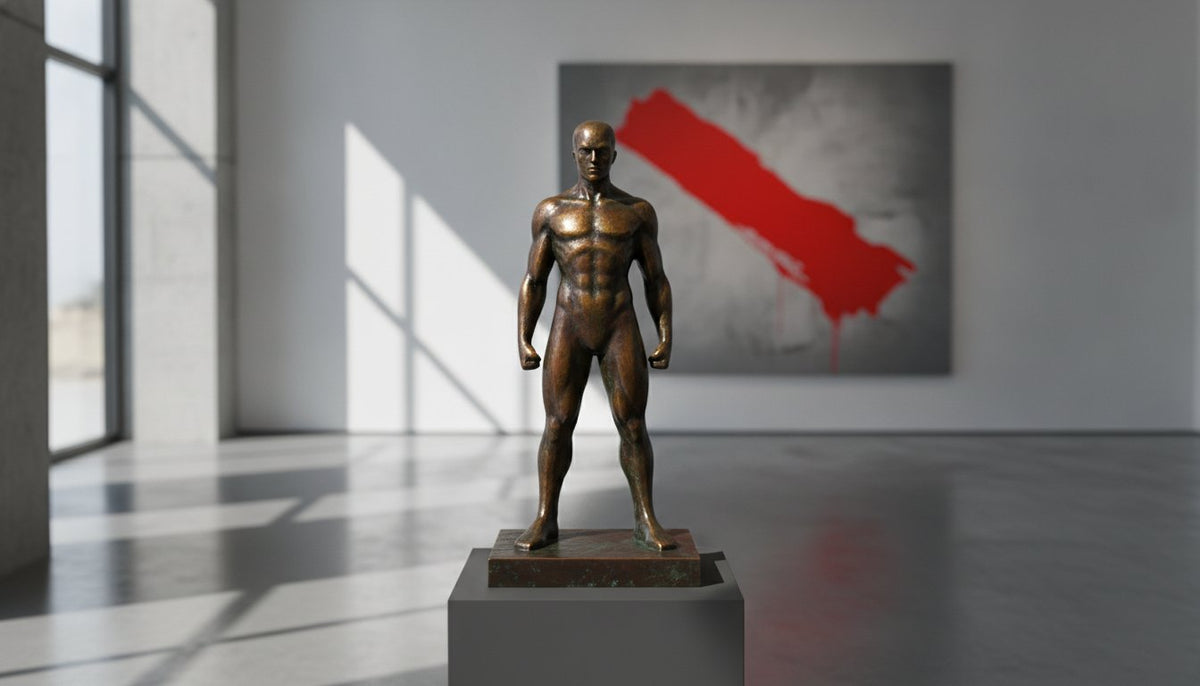
Investing in Bronze Sculptures: The Specification of Physical Permanence
Not everyone understands Mylo. That’s rather the point.
You've likely noticed the lack of physical presence in modern art and the exhaustion that follows digital volatility. Investing in bronze sculptures offers a necessary return to material truth. This analysis examines bronze as a high-end contemporary asset, focusing on narrative rarity and the lost-wax casting process. We'll examine the August 2026 commodity price of $19.85 per kilogram and the impact of the 28% capital gains tax on collectibles.
You'll find a breakdown of how limited edition numbering ensures provenance and why character-based sculpture provides a permanent physical anchor. There's a quiet dignity in owning a narrative that doesn't disappear when the power goes out. The quality of the object is a settled matter. These are the specifications of its permanence.
Key Takeaways
- Bronze acts as a physical anchor in volatile markets due to its composition as a copper and tin alloy with intrinsic commodity value.
- Investing in bronze sculptures secures a specific character narrative. It transitions ephemeral pop art into permanent fine art legacies.
- The lost-wax casting process ensures technical specifications and character details are preserved with total material truth.
- Chemical patination determines the final surface character. This allows the asset to develop a natural history that digital objects cannot replicate.
The Material Reality of Bronze in a Volatile Market
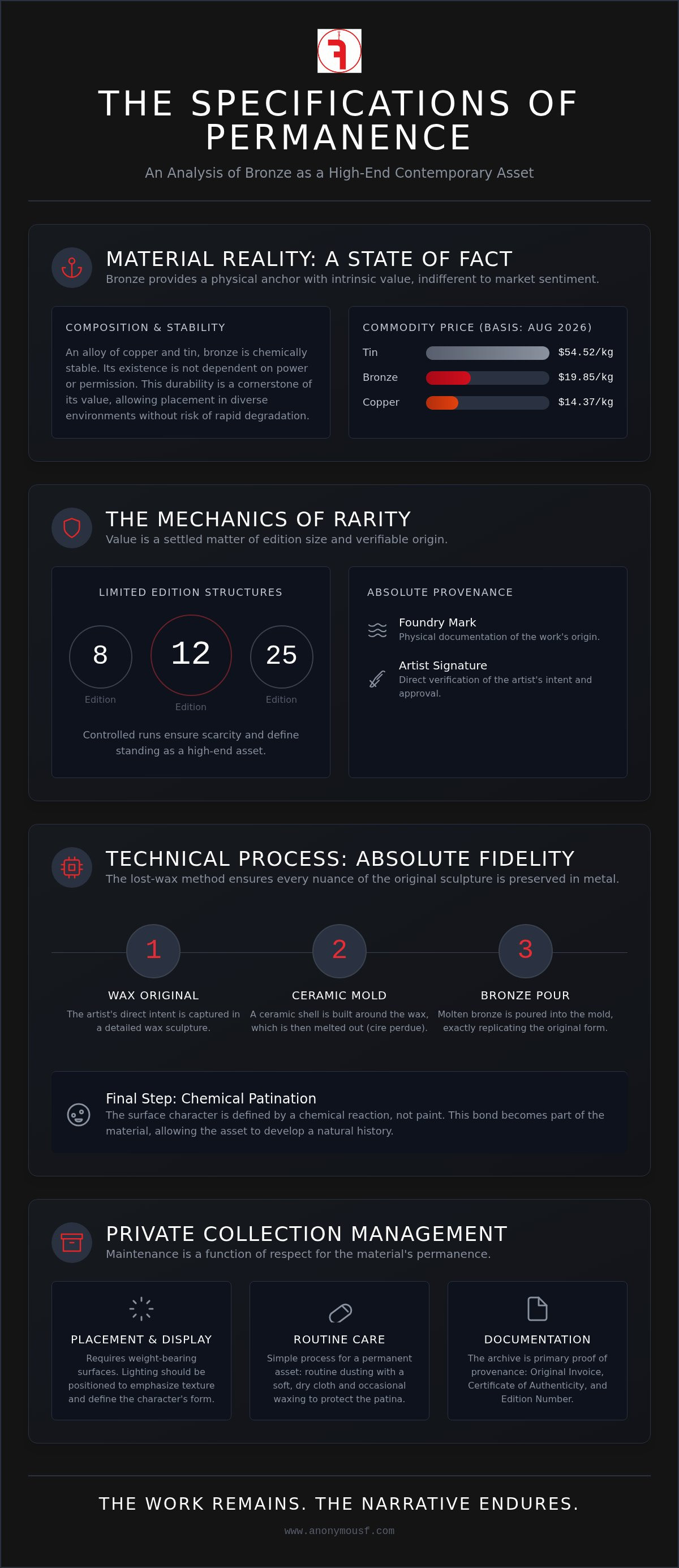
A digital asset exists in a state of permission. Bronze exists in a state of fact. As an alloy of copper and tin, the medium possesses an intrinsic commodity value that paper assets lack. In September 2026, the commodity price for bronze was recorded at $19.85 per kilogram. Copper traded at $14.37 per kilogram, while tin reached $54.52 per kilogram. These numbers provide a baseline of material worth that remains indifferent to market sentiment.
Investing in bronze sculptures involves acquiring an object that occupies physical space. It carries a narrative weight that digital assets cannot mimic. Unlike ephemeral materials, bronze is chemically stable. This allows for placement in diverse environments without the risk of rapid degradation. This durability is a cornerstone of the history of bronze sculpture. The object does not require a screen or a power source to verify its existence.
Edition Structures and the Mechanics of Rarity
Rarity in contemporary bronze is a calculation of volume and provenance. When investing in bronze sculptures, the mechanics of the multiple are paramount. Limited editions are typically cast in small, controlled runs. You'll find these restricted to numbers such as 8, 12, or 25. The foundry mark and the artist signature serve as the primary proof of provenance. They are the physical documentation of the work's origin. This creates a specific tension described in the Paradox of Permanence. The rarity of the multiple defines its standing as a high-end asset. A collector owns a specific character narrative that is finite and verifiable. The value is a settled matter of edition size and material truth.
Character-Based Bronzes: The Convergence of Pop Art and Fine Art
A collectible is a moment. A bronze is a legacy. For decades, pop art resided in the realm of vinyl and synthetic resins, materials that are inherently ephemeral. They serve a moment and then they degrade. Investing in bronze sculptures moves the narrative from a temporary trend into the permanence of fine art. It bridges the gap between the contemporary character and the historical monument with total material authority.
This shift is not merely structural. It is a transition of intent. Ownership of a specific character IP, such as Mylo, represents an investment in a unique narrative protected by the density of the alloy. The metal provides a physical anchor for a story that would otherwise remain digital or disposable. A collector who holds a character in bronze holds a settled truth. The value of original character IP resides in this intersection of pop culture and material permanence. It is a physical statement that requires no external validation.
Narrative Weight and the Quiet Boy Study
The Quiet Boy Bronze serves as a technical example of how narrative intent is captured in metal. Scale and material choice are not accidental. They dictate the emotional register. The specific gravity of the alloy ensures the character remains unmoved by environmental shifts. In narrative pop art, the "soul" of the character drives the value. It is the internal life of the figure that justifies the permanence of the cast. The dimensions of the piece create a presence that commands space. This is the reality of the work. It is an undecorated fact of its construction.
Technical Specifications and Maintenance for the Private Collection
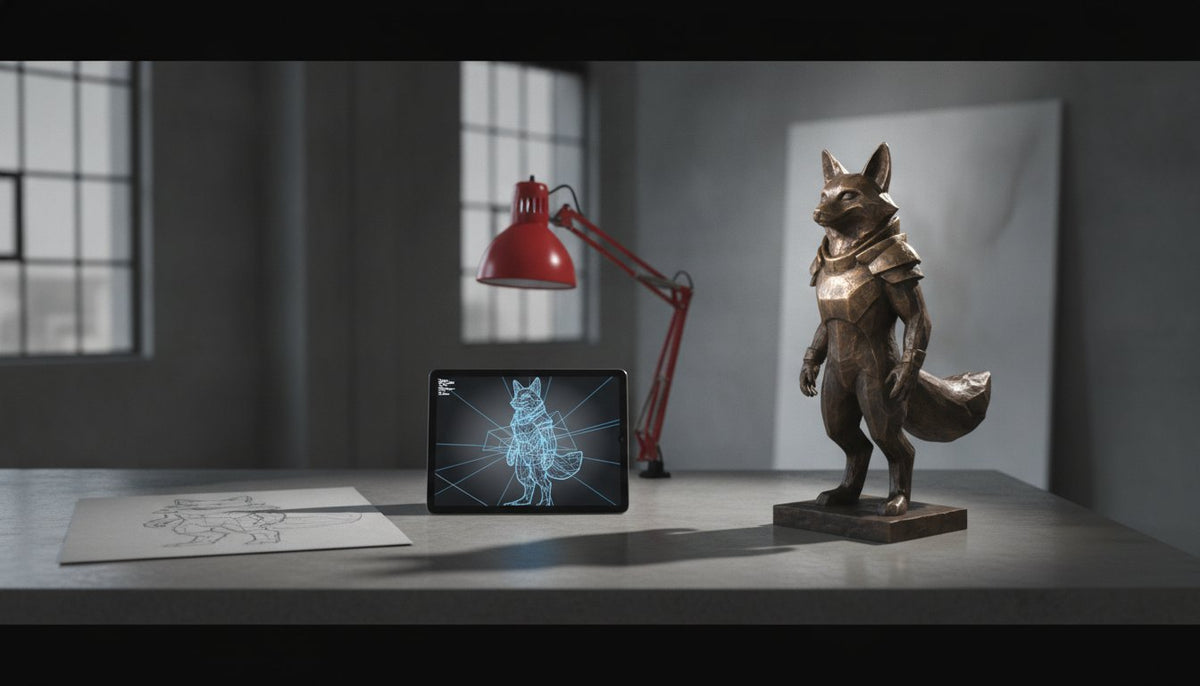
The lost-wax casting process, or cire perdue, is a method of absolute fidelity. It ensures that every nuance of the original character sculpture is preserved in metal. This technical specification is what validates the object. When investing in bronze sculptures, you aren't buying a mass-produced item. You're acquiring a cast that carries the direct intent of the artist's hands. The patination is a chemical process. It defines the final color and character of the surface through heat and oxidation. This isn't paint. It's a chemical bond that becomes part of the material itself.
Placement requires structural awareness. Bronze is heavy. Surfaces must be weight-bearing and stable. Lighting should be positioned to emphasize the texture of the cast, allowing shadows to define the character's form. The object demands its own environment. It doesn't ask for attention. It simply occupies it.
Managing the Physicality of the Investment
Maintenance is a function of respect for the material's permanence. Routine care involves dusting with a soft, dry cloth. Occasional waxing protects the patina from unwanted oxidation. This is a simple process for a permanent asset. Record-keeping is equally vital. Your archive must include the original invoice, the certificate of authenticity, and the specific edition number. These documents are the primary proof of provenance. They turn a physical object into a verifiable asset.
Investing in bronze sculptures is a settled matter of value. The work remains. The narrative endures. Its presence is the only proof required.
Securing the Physical Narrative
The transition from a temporary culture to a permanent legacy is a matter of material specification. Investing in bronze sculptures provides a physical anchor in a landscape defined by digital volatility. These limited edition character casts utilize the lost-wax casting method to ensure every detail remains a settled truth. With artist-direct provenance, the narrative weight of the object is verifiable and absolute. It's a return to the reality of the copper and tin alloy, a substance that remains indifferent to market sentiment.
There is a specific dignity in holding a story that doesn't depend on a screen. The collection represents a convergence of pop art and fine art legacy. Access The Bronze Collection at Fringe to review the available editions. Ownership is the final step in the shared philosophical observation of the collector and the creator.
Frequently Asked Questions
How do limited edition numbers affect the investment value of a bronze?
Limited edition numbers define the boundaries of a specific narrative. When investing in bronze sculptures, the total edition size, commonly restricted to 8, 12, or 25, establishes the asset’s rarity. While the specific number in the sequence rarely alters the price, the existence of a finite cap prevents the dilution of the work. The secondary market prioritizes the certainty of these closed production runs.
What is the difference between a foundry proof and an artist proof in bronze casting?
An artist proof (AP) is a cast reserved for the creator’s personal archive or exhibition use, typically limited to 10% of the main edition. A foundry proof (FP) is a technical standard used to verify the lost-wax casting process. Both exist outside the numbered run. They carry a distinct provenance because of their direct involvement in the artist’s studio or the foundry’s technical validation.
Why is character-based bronze considered a distinct asset class in contemporary art?
Character-based bronze represents a convergence of pop culture IP and high-end material truth. It moves narratives like Mylo or Nova from disposable materials into the permanence of a copper and tin alloy. This distinct asset class relies on the internal life of the character to drive value. It offers a physical anchor for stories that would otherwise remain ephemeral or purely digital.
Does the weight of a bronze sculpture influence its market price?
Market value is a function of provenance and edition rarity rather than raw material weight. The August 2026 commodity price of $19.85 per kilogram serves as a material floor, but the investment premium is found in the artist's intent. Heavy casts demand specific weight-bearing surfaces for display. However, the narrative weight of the character is the factor that determines the sculpture’s standing in a collection.

Article by
Fringe

Read more
Commissioning Custom Character Toys: The Specification of Physical Narrative
Not everyone understands the narrative weight of a bronze sculpture. That's rather the point. Most collectors are content with the oversaturation of low-quality vinyl toys that fill shelves and the...
Read more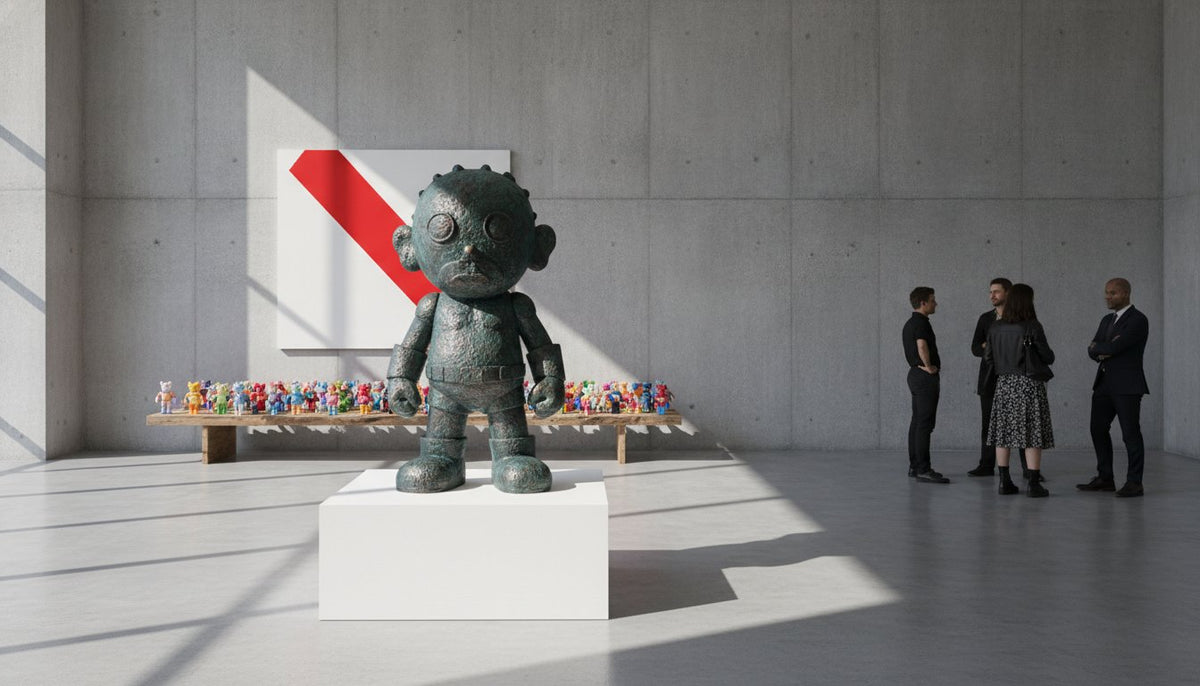
Investing in Collectible Art Toys: A Specification of Market Rarity
Not everyone understands Mylo. That is rather the point. The current saturation of generic vinyl has clouded the distinction between a mass-market product and a fine art sculpture. You likely feel ...
Read more
Leave a comment
This site is protected by hCaptcha and the hCaptcha Privacy Policy and Terms of Service apply.