
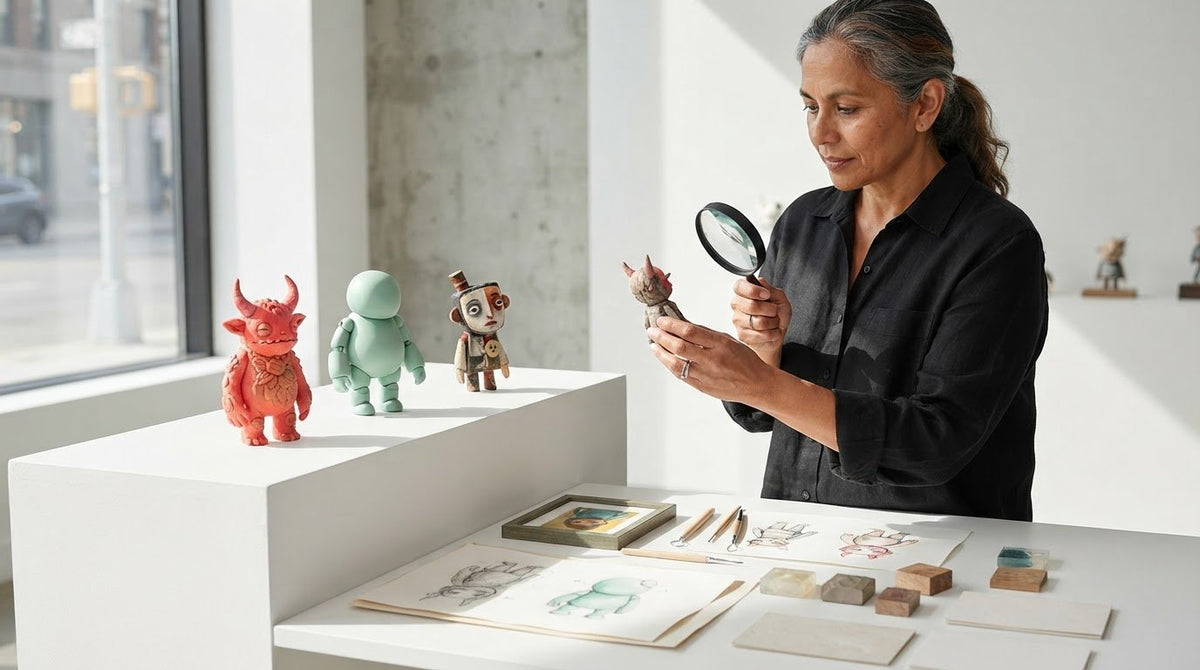
Independent Character Toy Artists: How to Read the Work
When discovering independent character toy artists, start with authorship, not the toy’s format. A recurring character is evidence of a practice, but it does not by itself establish who created the character.
Retail catalogues often place artists, brands, and product types side by side without showing who created a character or how an object fits into an artist’s work. For collectors, useful evidence is specific: consistent artist attribution, characters that recur across documented works, and facts attached to each physical piece.
Fringe is an independent artist-owned studio creating character-based collectible toys and other physical art. Mylo, Nova, and Gutinke are original characters within its work. To assess a practice like this, separate the artist’s wider body of work from the details of an individual object. Material, edition, dimensions, and provenance describe different things, and each belongs in the record only when documented.
Key Takeaways
- Separate the artist’s creative role from a brand’s, retailer’s, or manufacturer’s role.
- Trace character names across documented works to see whether they form a recognizable body of work.
- Read object records closely: attribution, medium, edition, and provenance are distinct facts.
- Fringe’s Mylo, Nova, and Gutinke are examples of original characters within an independent artist-owned practice.
What Makes an Independent Character Toy Artist Different from a Toy Brand?
A toy’s material tells you what it is made from. It does not identify who created its character.
An independent character toy artist builds work around characters they create and return to across a body of work. A toy brand may bring together products by different artists. A retailer sells or presents objects made by others. A manufacturer makes objects, but that role alone does not identify who created the character. These are different creative roles, not statements about legal rights.
Art toys, also called designer toys, include work by independent artists and designers. Within that category, a character appearing across an artist’s documented work can offer a stronger clue to an individual practice than format alone. A vinyl figure and a resin figure may share a material category; neither material establishes authorship.
What evidence points to an artist-led character practice?
Start with attribution. Look for the same artist named consistently alongside character work and related physical art. Fringe, for example, is an independent artist-owned brand and studio whose work includes character-based collectible toys and other physical art. Its original characters include Mylo, Nova, and Gutinke. The Fringe artist page provides an artist reference point.
Named characters can connect works within a practice. They do not, on their own, establish ownership rights, edition rights, or an object’s production history. Those are separate claims and require their own supporting records.
When assessing independent character toy artists, separate what the record states from what the object suggests. Attribution and a character name can indicate a creative connection. Medium, edition, and provenance are separate facts. Check each against the information for the individual object. A format is a category. Authorship is a practice.
How to Assess Independent Character Toy Artists Through Their Work
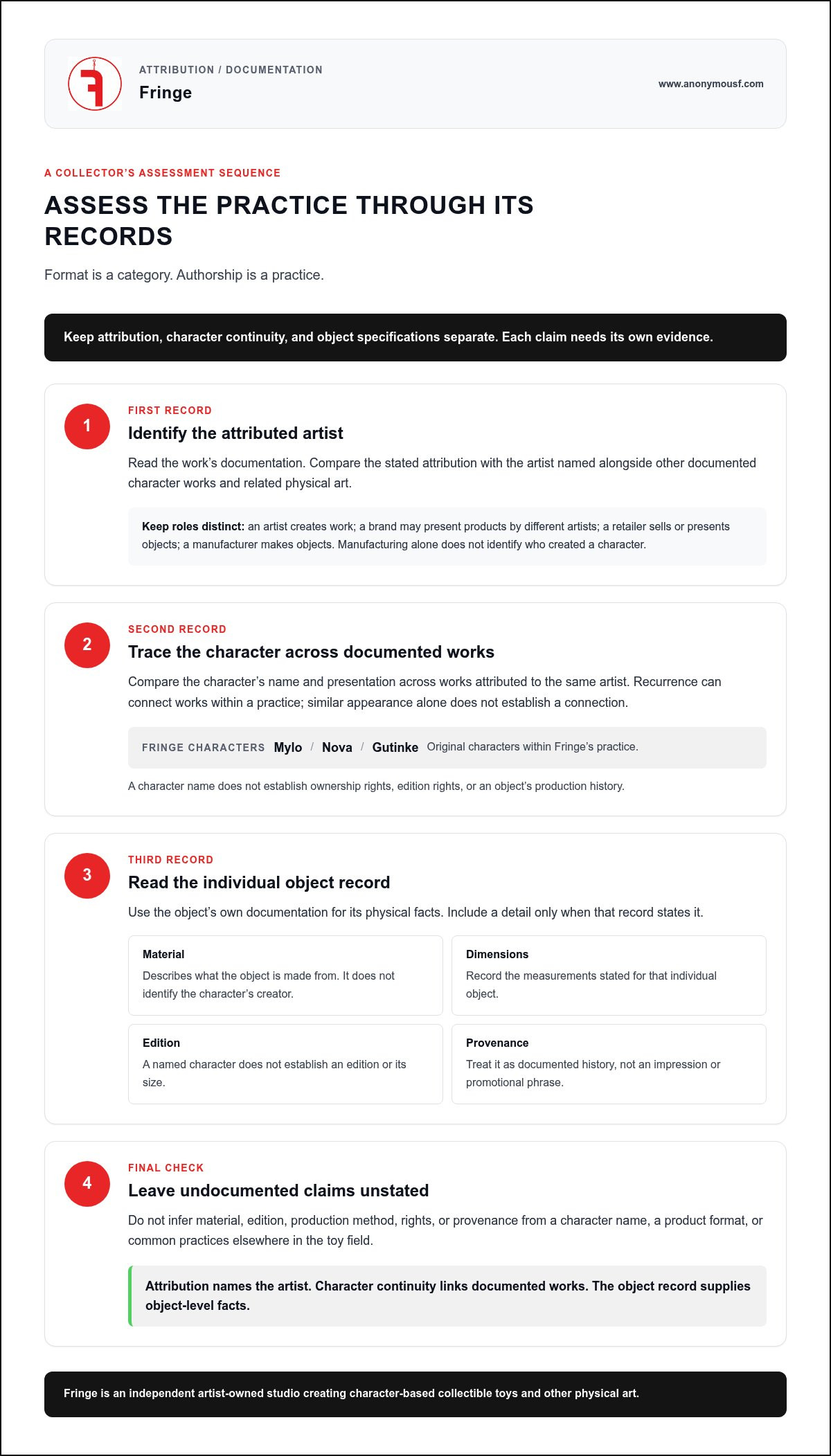
Use a clear sequence. Identify the artist named in the work’s documentation. Trace the character name across that artist’s documented works. Then read the record for the individual object. This separates attribution, character continuity, and physical specifications instead of treating them as one claim.
For context, The Toy Association, a U.S. toy industry trade association, represents the wider toy industry. An artist’s practice is assessed through evidence attached to their work, not through the breadth of a retail catalogue.
Which details help distinguish a character from a product description?
A product description may identify an object by format or stated material. A character’s name and presentation across an artist’s documented works can show continuity within a practice. Compare the records directly. Similar appearance alone does not establish a connection.
- Artist: Check the stated attribution for the work and compare it with the artist’s other documented pieces.
- Character: Compare the name and presentation across documented works. Note where the evidence comes from.
- Object: Use material, dimensions, and edition details only when the individual object’s record states them.
- Provenance: Treat it as a documented history, not an impression or promotional phrase.
These details are not interchangeable. A named character does not establish an edition, and a material description does not establish authorship. If specifications are absent, do not infer them from common materials, production methods, or edition practices elsewhere in the toy field.
When discovering independent character toy artists, keep the assessment close to the evidence: who is attributed, which character recurs, and what the object record states. Interpretation can follow the facts, not replace them.
Fringe’s Character Toys as Part of an Independent Artist’s Practice
Fringe is an independent artist-owned brand and studio. Its physical work includes character-based collectible toys, bronze sculptures, oil paintings, limited edition prints, and hybrids on paper. These forms belong to one artist-led practice, but they do not share the same materials, production methods, or object specifications.
For collectors discovering independent character toy artists, Fringe offers a clear example of named characters within an artist’s work. Mylo, Nova, and Gutinke are original characters. Their names identify a connection to Fringe’s character work; details such as material, edition, dimensions, and provenance belong to the record for each object.
How do Mylo, Nova, and Gutinke anchor the discussion?
Each name identifies an original character within Fringe’s practice. Read the names as evidence of authored characters, not as shorthand for unverified biographies or production facts. A character may recur across works, while each physical object still has its own record.
Fringe’s collectible character toys provide a focused reference to that part of the studio’s work. The wider practice includes bronze sculpture and works on paper. A different medium does not, by itself, indicate the same character or process.
The evidence is specific. Mylo, Nova, and Gutinke are original characters associated with Fringe, and the studio creates collectible toys and other physical art. Edition size, material, and provenance are object-level details, not facts to infer from a character’s name.
Read the Character, Then the Record
Independent character toy artists are identified through a connected practice, not a shelf label. Consistent attribution indicates who is named as the artist; a recurring character name can link works across that practice. Material, edition, dimensions, and provenance remain separate object facts. If the record is silent, leave the claim unstated. A retail category can help locate an object, but it cannot replace attribution or documentation.
That distinction matters when discovering independent character toy artists. Fringe is an independent artist-owned brand and studio whose physical art includes character-based collectible toys. Mylo, Nova, and Gutinke are original characters. These facts establish a connection between the characters and the studio’s work without implying an undocumented backstory, material, or edition.
A toy can carry a character’s identity and still be a specific physical object with its own record. Read both levels carefully. The character connects the work; the record describes the object. That is enough to make a sound assessment.
Frequently Asked Questions
What makes a character toy artist independent?
An independent character toy artist is identified by an artist-centred practice, not by a retail label. Look for a creator credited consistently across character work and other documented pieces. Named characters and a connected body of work can show continuity. These clues describe the visible record; they do not establish legal ownership, production arrangements, or distribution.
How can I identify an original character toy artist?
Check the stated artist attribution, compare character names across documented works, and read the details for each object. When discovering independent character toy artists, keep observation separate from inference: a repeated name may indicate continuity, but a name alone does not prove authorship, ownership, rarity, or production method. Treat medium, edition, and provenance as facts only when the records state them.
Are independent character toys always limited editions?
No. “Independent” describes an artist-centred practice, not the number of objects made. Edition size applies to a specific work and should be stated in that object’s record. Do not infer a limited run, numbering, scarcity, or future availability from an artist’s independence or a toy’s format. If the record gives no edition information, leave the edition unstated.
Where can I see an artist’s wider character toy practice?
An artist profile and a character-toy category show different parts of a practice: attribution and the objects grouped under that work. Fringe’s artist profile provides an artist reference, while Fringe’s collectible-toy category presents that part of the studio’s physical art. Mylo, Nova, and Gutinke are original characters; individual specifications belong to their object records.

Article by
Fringe

Read more
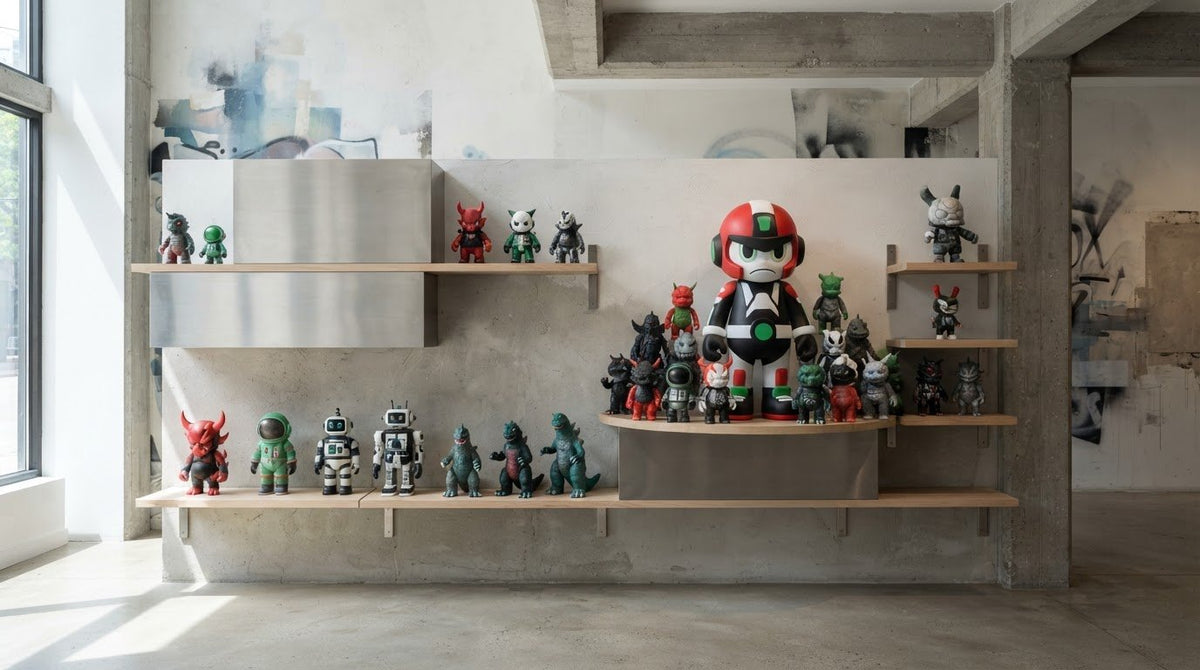
How to Display Designer Toys: A Collector’s Guide
A shelf can hold a collection and still hide its figures. Knowing how to display designer toys starts with the main viewing position: each face, outline, and defining detail should remain visible. ...
Read more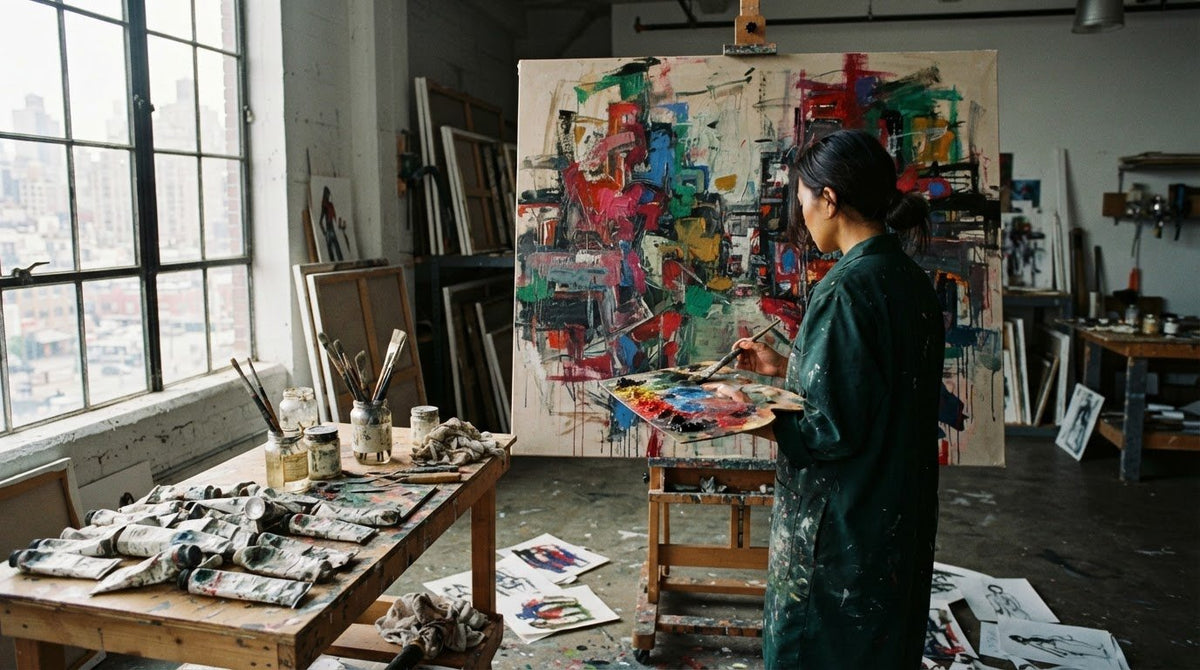
The Creative Process of an Oil Painter: Decisions, Revisions, and Material
An oil painting records decisions, not a fixed sequence. The creative process of an oil painter may begin with a reference, a memory, or a compositional problem, then change as forms, colors, and e...
Read more
Leave a comment
This site is protected by hCaptcha and the hCaptcha Privacy Policy and Terms of Service apply.