

Documenting Provenance for Your Artwork: A Collector’s Record
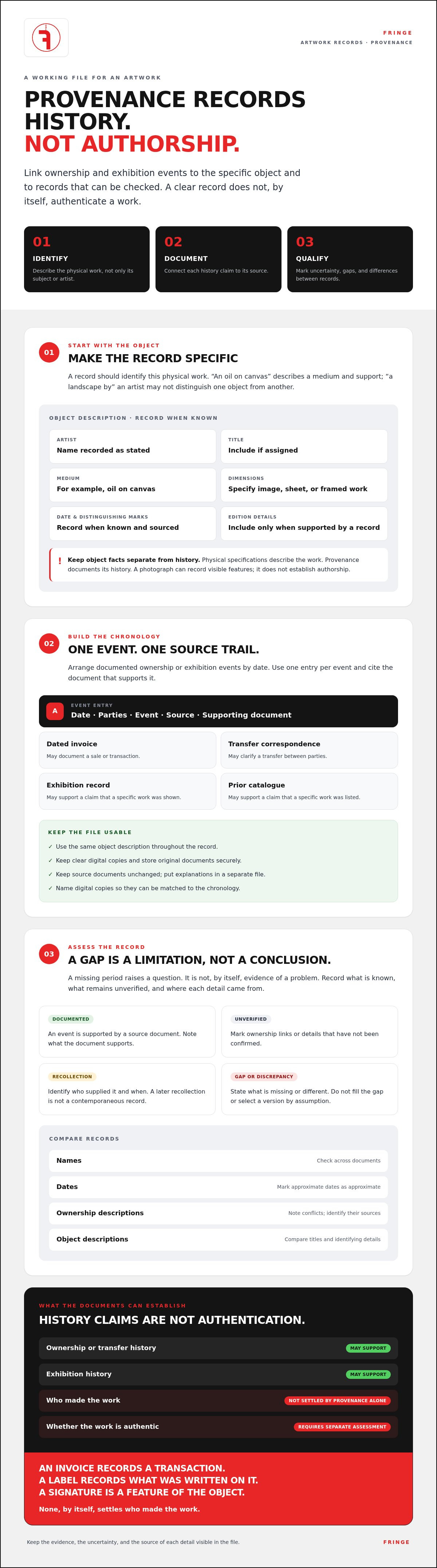
An artwork’s paperwork records a history; it doesn’t, by itself, prove who made it. Documenting provenance for your artwork means linking known ownership events to details about the specific object and records that can be checked.
A gap can raise questions, but it isn’t evidence of a problem on its own. Don’t fill it with an assumption. Record what’s known, what remains unverified, and where each detail came from.
This article explains which records to keep and how to organise them so the file can be updated over time. It also shows how to separate documented facts from claims, and what provenance can and can’t establish. A clear record matters, but authentication is a separate question.
Key Takeaways
- Start with details that identify the physical work, including its medium and distinguishing features, rather than relying on its subject or artist alone.
- When documenting provenance for your artwork, gather records that support specific ownership or exhibition events, then arrange them by date.
- Compare names, dates, and object descriptions across records. Flag differences rather than resolving them through assumption.
- Keep copies of supporting documents and note where the record has gaps, so future updates distinguish verified details from unconfirmed claims.
Documenting Provenance for Your Artwork Starts with the Object
Provenance is the documented account of an artwork’s history and ownership. It records what can be supported about an object and the people or institutions connected to it. A useful starting point is the chronology of the ownership, but a sequence of ownership claims is not an authentication finding. Provenance supports a history claim. It does not, by itself, prove who made the work or whether it is authentic.
Begin with the physical work, not just its subject or the artist’s name. A record for an oil on canvas should identify that specific object, rather than simply referring to “a landscape by” an artist. The same principle applies to a bronze sculpture, a print, or a work on paper. For a character-based collectible, record the character name alongside any title or distinguishing features that can be verified. Fringe’s artist biography provides artist context; the object record needs to describe the specific work.
Which details identify an artwork without ambiguity?
Record the artist, title if assigned, medium, dimensions, date, and distinguishing marks when known. Use clear measurements and specify whether they describe the image, sheet, or framed work. For an edition, include the stated edition number and details only when supported by a record. Don’t fill missing information in from memory.
These details help distinguish one object from another when invoices, correspondence, or catalogues use abbreviated descriptions. A photograph can document visible marks or features, but it doesn’t establish authorship. Tie each detail to its source, and label information that remains unverified.
Physical specifications and provenance answer different questions. One describes the object; the other documents its history. Both require precision.
Build an Artwork Provenance Record One Document at a Time
A reliable record grows from evidence, not from a polished story. When documenting provenance for your artwork, connect each ownership or exhibition claim to the source that supports it. A dated invoice may document a sale; correspondence may clarify a transfer; an exhibition record or prior catalogue may support a claim that a specific work was shown or listed.
Build the file in a clear sequence:
- Identify the work. Use the same object description throughout the record.
- Gather relevant documents. Include invoices, transfer correspondence, exhibition records, or catalogues when they support a specific claim about the work.
- Order documented events by date. For each entry, record the date, parties involved, event, source, and supporting document.
- Mark uncertainty. Label approximate dates, unverified ownership links, and details based on later recollection.
- Preserve the file. Keep clear digital copies and store original documents securely.
How should collectors organise provenance documents?
Use a chronology with one entry per event and a reference to its source document. Distinguish records created at the time, such as an invoice from the transaction, from later recollections about an earlier owner. A recollection may provide useful context, but it isn’t the same as a contemporaneous record. If a date is uncertain, mark it as approximate instead of assigning a precise year.
Keep source documents unchanged. Don’t write on originals or edit scans in ways that obscure their contents. Add explanations in a separate file, and name digital copies so they can be matched to the chronology. Keep object details in the work’s description rather than adding assumptions to a sale record. The file should show what each document supports and what it doesn’t.
Assess Provenance Gaps Before You Rely on an Artwork’s History
Compare each record with the others. Check names, dates, ownership descriptions, and object details. An invoice may describe a work by one title while a later catalogue uses another. A transfer letter may give a different date from a sales record. Note the discrepancy and identify the documents that contain it. Don’t choose the version that makes the history appear more complete.
A missing period in the record is a limitation to disclose, not a blank to fill with a plausible owner. If a date or ownership link comes from someone’s later recollection, label it as recollection and note who supplied it and when. In documenting provenance for your artwork, separating evidence from inference is part of keeping a reliable record.
What can provenance establish, and what remains unproven?
Documents may support claims about ownership, transfer, or exhibition history. They don’t independently establish authorship or authenticity. An invoice records a transaction; a label records what was written on it; a signature is a feature of the object. None, by itself, settles who made the work. Authentication requires an assessment beyond the existence of an ownership record.
Provenance records document history, not certainty about authorship.
For an unresolved gap or conflict, ask the relevant seller, previous owner, gallery, or institution whether supporting records exist. Keep the request and any reply with the file, including responses that add no new evidence. State plainly what remains unknown. A record is more useful when its limits are visible.
Keep the Record Clear as Ownership Changes
A useful provenance file identifies the physical work, connects each ownership or exhibition claim to a source, and separates documented facts from recollections or assumptions. Record missing periods as gaps, not as invitations to create a continuous history. Provenance documents history; it doesn’t establish authorship on its own.
These distinctions matter across media. Fringe offers oil paintings, bronze sculptures, works on paper, limited edition prints, and character-based collectible toys. Each object needs a record specific enough to distinguish it from another work or edition.
Documenting provenance for your artwork is an ongoing practice. Add records when new information becomes available, preserve original documents, and keep unresolved differences visible. The history may remain incomplete, but a careful account can still be clear, useful, and honest.
Frequently Asked Questions
Is provenance the same as authentication?
No. Provenance documents an artwork’s history and ownership, while authentication concerns whether the work is correctly attributed to its maker. An invoice or a sequence of ownership records can support a history claim, but it doesn’t prove authorship. Keep the questions separate, even when a record includes an artist’s name or a description of the work.
What documents can help establish an artwork’s provenance?
Dated invoices, transfer correspondence, exhibition records, and prior catalogues can support specific claims about ownership or a work’s history. Their usefulness depends on whether they identify the particular object and substantiate the event described. Record who created or supplied each document and which claim it supports. A document’s existence alone doesn’t verify every statement in it.
Can an artwork have provenance if earlier records are missing?
Yes. Available documents can establish parts of an artwork’s history even when earlier records are absent. Describe the documented periods and identify the gap; don’t invent a continuous chain of ownership. If someone provides a later recollection about an earlier owner, label it as a recollection and record its source. A gap limits what can be claimed, but it doesn’t erase documented events.
How should I keep provenance records for my artwork?
For documenting provenance for your artwork, keep a dated chronology that links each ownership or exhibition event to its source. Store clear digital copies, retain originals securely, and keep source documents unaltered. Label uncertain dates and ownership links rather than presenting them as established facts. Add new evidence as it becomes available, while preserving earlier entries so changes to the record remain clear.
Explore Fringe’s artist biography and discover the artist behind its original pop art and character-based collectible toys.

Article by
Fringe

Read more
Art Collecting for Beginners: A Practical Guide
A first collection is defined by its criteria, not its price tag. The most useful art collecting for beginners tips start with deciding what you want to live with, then applying that standard consi...
Read more
Mistakes to Avoid When Buying Art Online
The photograph isn’t the artwork. The most consequential mistakes to avoid when buying art online happen when a screen image is treated as a complete account of the object. A photograph can flatten...
Read more
Leave a comment
This site is protected by hCaptcha and the hCaptcha Privacy Policy and Terms of Service apply.