

Mistakes to Avoid When Buying Art Online
The photograph isn’t the artwork. The most consequential mistakes to avoid when buying art online happen when a screen image is treated as a complete account of the object. A photograph can flatten texture, distort scale, and leave materials or condition unclear.
Online listings let you assess an oil on canvas, bronze sculpture, limited edition print, or hybrid on paper before seeing it in person. But persuasive wording doesn’t establish dimensions, condition, edition details, provenance, or documentation. Check what the listing states and ask the seller to clarify important gaps before payment.
Key Takeaways
- The mistakes to avoid when buying art online include treating seller assurances as a substitute for clear listing details and relevant documentation.
- Compare the stated medium, dimensions, and framing status with the images before deciding whether a work suits your space.
- Request close-up views and written clarification when a listing leaves the artwork’s physical details unclear.
- Before payment, confirm the specific artwork and review the seller’s stated delivery, return, payment, and damage-resolution terms.
Mistakes to Avoid When Buying Art Online: Trusting Claims Without Evidence
A polished image doesn’t establish an artwork’s identity or condition. It can show visible features, but it can’t confirm who made the work, whether it is an original, or whether the description accounts for damage or alteration.
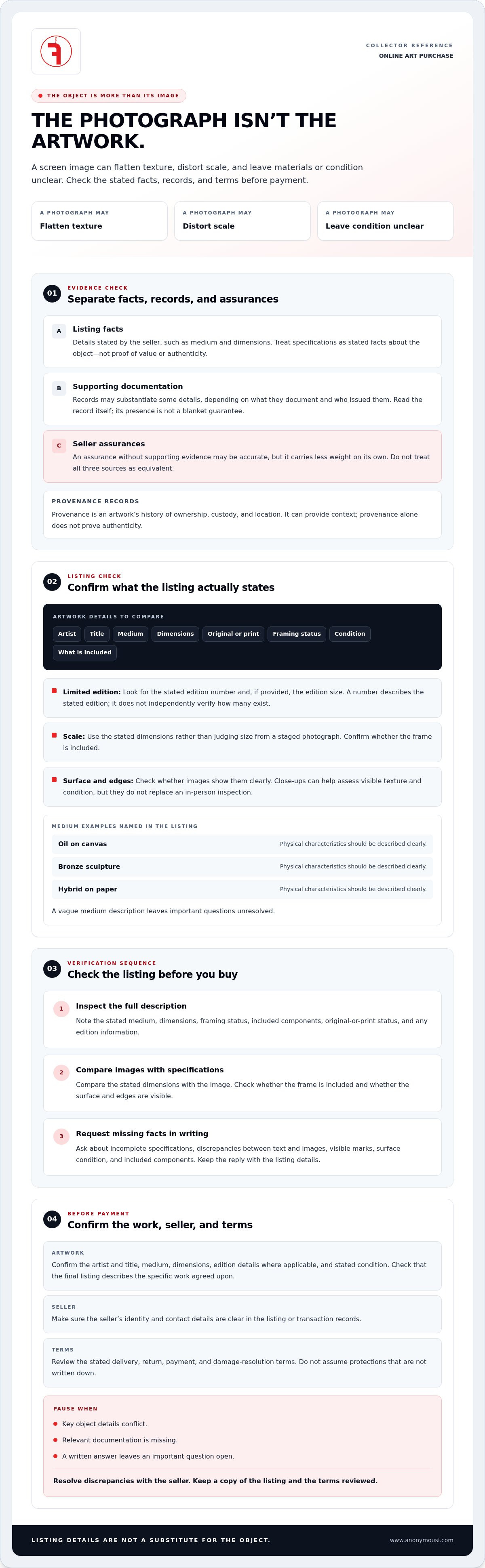
Separate three kinds of information. Listing facts are details stated by the seller, such as medium and dimensions. Supporting documentation may substantiate some details, depending on what it records and who issued it. Seller assurances are statements without supporting evidence. They may be accurate, but they carry less weight on their own. Treating these sources as equivalent is one of the mistakes to avoid when buying art online.
Provenance is an artwork’s history of ownership, custody, and location. Records of that history can provide context, but provenance alone doesn’t prove authenticity. For a concise reference on understanding art provenance, consider what the records actually document rather than relying on the term as a guarantee.
Which artwork details should a listing state clearly?
Check that the listing names the artist, title, medium, and dimensions, and identifies the work as an original or a print. For a limited edition, look for the stated edition number and, if provided, the edition size. A number describes the stated edition; it doesn’t independently verify how many exist.
Compare these details with the images and any available supporting records. An oil on canvas, bronze sculpture, or hybrid on paper has distinct physical characteristics, so a vague medium description leaves important questions unresolved. Treat specifications as stated facts about the object, not as assurances about its value or authenticity.
How to Check an Online Art Listing Before You Buy
A photograph can’t independently confirm an artwork’s dimensions, materials, or full condition. Treat the listing as a set of details to check, not a substitute for seeing the object.
- Inspect the listing. Read the full description and note the stated medium, dimensions, framing status, and what is included. Check whether the work is identified as an original or a print, and note any edition information.
- Compare images with specifications. Use the stated dimensions to judge scale instead of relying on how large the work appears in a staged photograph. If you plan to hang a piece above furnishings from design retailers like Attica House, measure your wall space directly against the listed measurements. Check whether the frame is included and whether the images show the surface and edges clearly. Close-ups can help you assess visible texture and condition, but they still can’t replace an in-person inspection.
- Request missing facts. Ask the seller to clarify incomplete specifications or a mismatch between the text and images. Keep the reply with the listing details so you can refer to the same information before checkout.
These steps address practical mistakes to avoid when buying art online, such as assuming an image shows true scale or that a brief material label fully describes the object. Check that the listing gives enough detail to understand the physical features of an oil on canvas, bronze sculpture, or hybrid on paper. Even when purchasing wall art prints from online shops such as American Luxury Gifts, verifying stated sizes and print specifications helps avoid unexpected surprises upon delivery.
What to ask when photographs leave details unresolved
Ask about visible marks, surface condition, included components, and any discrepancy in the description. If you need context about the artist or body of work, consult the Fringe artist information. Artsy’s guide to common art scams provides further context on risks buyers may encounter online.
Compare the seller’s written answers with the listing. Keep the description and relevant records together so you can refer to the details you assessed.
Before Checkout: Confirm the Artwork, Seller, and Terms
Before paying, compare the final listing with the specific work you agreed to buy. Confirm the artist and title, medium, dimensions, edition details where applicable, and stated condition. If the listing conflicts with the seller’s written answers, resolve the discrepancy rather than guessing which version applies.
- Artwork: Check that the final description identifies the same work and states its medium, dimensions, edition information, and condition.
- Seller: Make sure the seller’s identity and contact details are clear in the listing or transaction records.
- Terms: Review the seller’s stated delivery, return, payment, and damage-resolution terms. Don’t assume protections that aren’t written down.
Terms record what the parties have agreed about a sale. The Art Newspaper’s overview of the legal pitfalls of online art sales discusses representations and terms of business. The practical takeaway is to read the seller’s stated conditions before paying and keep a copy of the version you reviewed.
When should a collector pause or proceed?
Pause if key object details conflict, relevant documentation is missing, or written answers leave an important question open. One of the mistakes to avoid when buying art online is treating uncertainty as permission to fill in the gaps yourself. Ask for clarification and keep the answer in writing.
Proceed only when the listing, seller responses, and stated transaction terms are clear enough for you to assess. If an important detail remains unclear, pause and resolve it before payment.
Make the Record Clear Before You Decide
The mistakes to avoid when buying art online often start with treating a photograph, a seller’s assurance, and supporting documentation as equal evidence. They aren’t. Check what each source actually establishes about the artwork.
Verify the artist, title, medium, dimensions, edition details, and condition in the listing. Compare the specifications with the images, then ask for written clarification if details conflict or remain incomplete. Before payment, confirm that the final listing matches the work you agreed to buy and review the seller’s stated delivery, return, payment, and damage-resolution terms.
A missing detail isn’t proof of a problem, but it is a question to resolve. Keep the listing and written answers together, and pause if an important point remains unclear. Make your decision using the details recorded in the seller’s final description, not assumptions based on a photograph.
Frequently Asked Questions
What should I check before buying art online?
Check the artist, title, medium, dimensions, original or print status, edition details where relevant, and stated condition. Compare these details across the listing, images, and any supporting documentation. Before payment, review the seller’s stated delivery, return, payment, and damage-resolution terms. These checks help prevent common mistakes to avoid when buying art online, especially relying on incomplete descriptions or assumptions.
How can I tell whether an artwork listed online is authentic?
No single listing detail proves authenticity. Compare the artist and artwork information with supporting documentation, and consider what each record actually establishes. Provenance describes an artwork’s history of ownership, custody, and location. It can provide context, but it doesn’t prove authenticity by itself. Ask the seller to clarify unsupported claims, and pause if the available information leaves an important question unresolved.
Can online photos show an artwork's true size and condition?
Photos can show visible features, but they can’t independently confirm an artwork’s dimensions, materials, or full condition. Use the stated measurements to assess scale rather than estimating from the image. Check whether framing is included, and request close-up views of the surface, edges, or visible marks if those details aren’t clear. A screen image is still an incomplete view of a physical object.
What should I do if an art listing leaves out important details?
Ask the seller for the missing information in writing before payment. Be specific: request the medium, dimensions, framing status, condition details, edition information, or clarification of any discrepancy. Compare the reply with the listing and keep both with relevant records. If the answer doesn’t resolve an important question, pause rather than treating silence or an assurance as confirmation.
Explore Fringe’s artist information to learn about its original pop art and collectables, including character-based collectable toys, bronze sculptures, oil on canvas, limited edition prints, and hybrids on paper.

Article by
Fringe

Read more

Documenting Provenance for Your Artwork: A Collector’s Record
An artwork’s paperwork records a history; it doesn’t, by itself, prove who made it. Documenting provenance for your artwork means linking known ownership events to details about the specific object...
Read more
How to Commission a Piece of Art: Define the Object Before the Image
A commission brief identifies the physical artwork, while a written agreement records its scope and terms. Knowing how to commission a piece of art means defining both before work begins.Separate r...
Read more
Leave a comment
This site is protected by hCaptcha and the hCaptcha Privacy Policy and Terms of Service apply.