
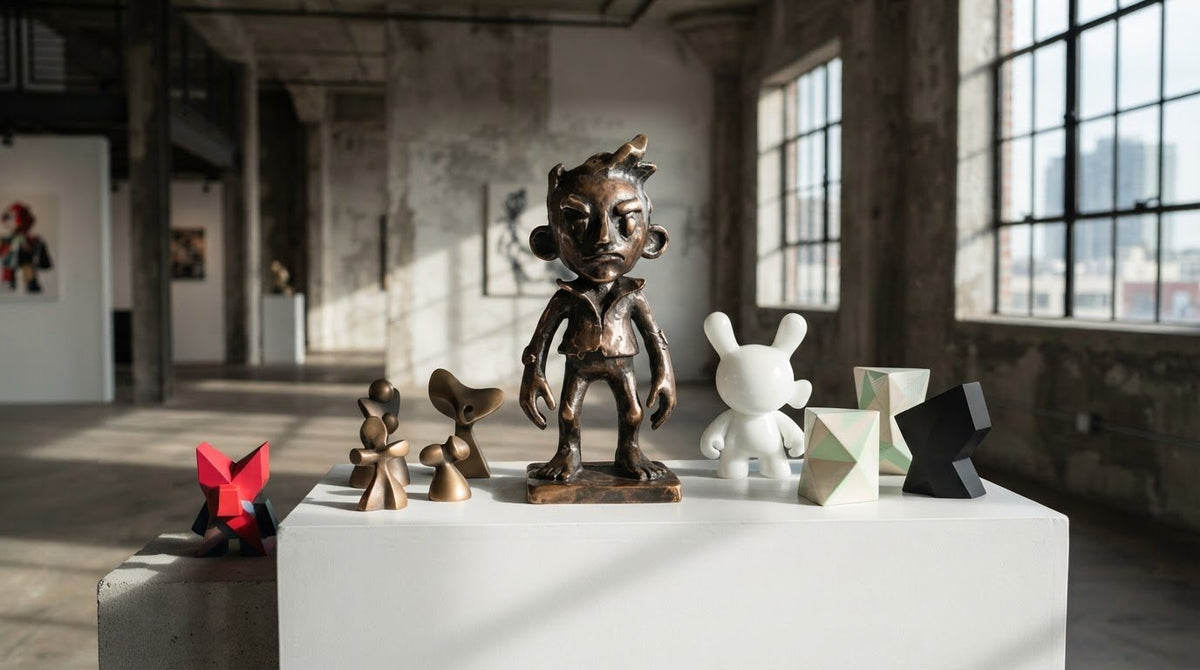
Contemporary Sculpture Collectibles: Material, Character and Authorship
A contemporary sculpture collectible is a physical object whose medium, scale, finish and authorship can be recorded separately. The category label is only a starting point. The object’s stated details give you firmer grounds for comparison.
Sculptures, design objects and character toys can sit close together in a collection. To distinguish them, read the stated category alongside the material and form. A shared material or character does not make two objects the same kind of work.
A useful comparison records what is known about the object, then leaves interpretation where it belongs: with the viewer. The practical fields are material, scale, finish, form and authorship. Fringe’s Mylo Bronze offers a clear example, with a named character, bronze construction and a stated height.
Key Takeaways
- Assess a contemporary sculpture collectible by separating stated facts, such as medium and finish, from personal interpretation.
- Compare works using consistent fields: category, material, scale, finish and character.
- Mylo Bronze stands 60 cm tall and comprises nine unique bronzes: six hand-painted and three high-polished. One of a kind, hand-signed, and framed. Certificate of Authenticity (COA) issued by Anonymous F ©.
- A character’s appearance does not determine whether an object is a sculpture or a collectible toy. Read its stated form and category.
What Makes a Contemporary Sculpture Collectible?
A contemporary sculpture collectible is a physical artwork with a form, material, scale and authorship that can be described. Those details identify the object. A viewer’s response to its character is interpretation, not a product specification.
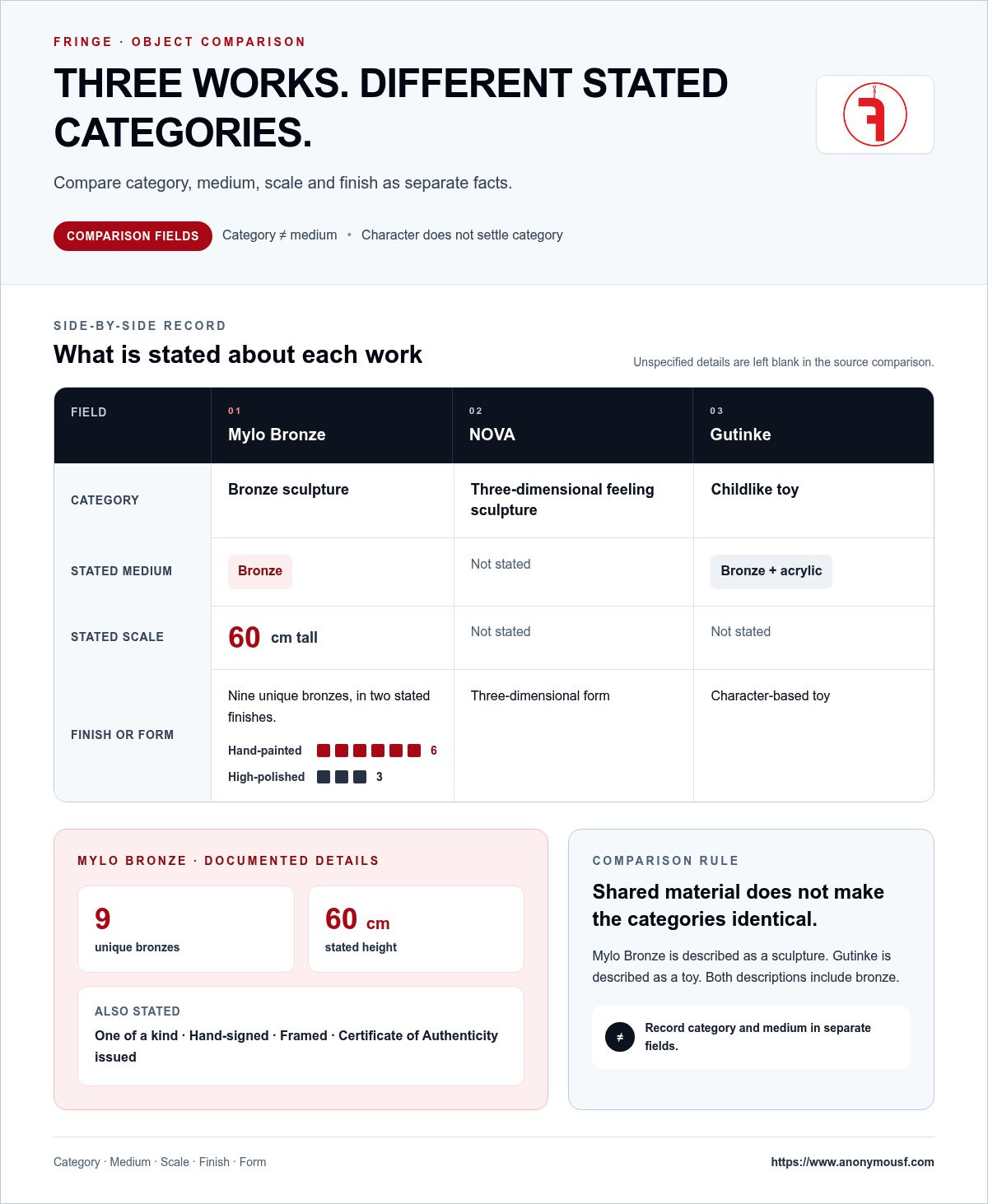
Fringe describes Mylo Bronze as a bronze sculpture and Gutinke as a childlike toy in bronze and acrylic. The shared use of bronze does not make their categories identical. NOVA is a three-dimensional “feeling sculpture.” Its concept and physical form belong in the description; a viewer’s response remains personal.
Which physical qualities help distinguish one sculpture from another?
Record category, medium, dimensions and finish as separate facts. For Mylo Bronze, the stated height is 60 cm. The nine unique bronzes comprise six hand-painted works and three high-polished works. These details let you compare scale and surface treatment without treating either as a measure of quality.
- Category and medium: Mylo Bronze is a bronze sculpture; Gutinke is a toy made of bronze and acrylic.
- Scale: Mylo Bronze stands 60 cm tall.
- Finish: Mylo Bronze comprises six hand-painted bronzes and three high-polished bronzes.
- Form and character: NOVA is a three-dimensional feeling sculpture.
How to Compare Contemporary Sculpture Collectibles by Material and Form
Use the same fields for each object. Start with its stated category and medium, then record scale and finish where specified. Keep interpretation separate from the description. This avoids common mistakes, such as treating a shared material as proof that two works belong to the same category, or assuming that a character toy is a sculpture simply because it has a sculptural form.
| Work | Stated category and medium | Stated scale | Stated finish or form |
|---|---|---|---|
| Mylo Bronze | Bronze sculpture | 60 cm tall | Six hand-painted bronzes and three high-polished bronzes |
| NOVA | Three-dimensional feeling sculpture | Three-dimensional form | |
| Gutinke | Childlike toy in bronze and acrylic | Character-based toy |
How do medium, scale and finish change the reading of a work?
Medium tells you what a work is made from. It does not, by itself, define the work’s category. Mylo Bronze is described as a sculpture, while Gutinke is described as a toy; both descriptions include bronze. NOVA is described through its three-dimensional form and feeling-sculpture concept. Compare these facts in separate fields rather than collapsing them into a single judgment.
The Mylo Bronze collection connects the named character with a physical bronze sculpture. The work is one of a kind, hand-signed, and framed. Certificate of Authenticity (COA) issued by Anonymous F ©. For broader context on material and the figure in sculpture, Christie’s guide to collecting 20th- and 21st-century sculpture discusses how artists approach those concerns. A careful comparison keeps object details distinct from personal preference.
Character-Based Contemporary Sculpture in Fringe's Mylo Bronze
Fringe’s Mylo Bronze is a contemporary sculpture collectible built around a named character and a specific material. The bronze sculpture stands 60 cm tall. Its physical form and character are part of the work’s identity; they do not establish how a viewer will respond to it.
What does Mylo Bronze show about character and sculptural form?
Mylo Bronze comprises nine unique bronzes: six hand-painted and three high-polished. These are distinct works, not interchangeable finish options. Bronze is the stated material, and 60 cm is the stated height. Together, those details describe the sculpture’s physical form and surface.
The name Mylo identifies the character within Fringe’s sculptural practice. The figure takes physical form in bronze. That is the distinction between a character’s name and the object itself: one identifies the figure, the other gives it material and scale.
The Mylo Bronze collection identifies the sculpture within Fringe’s work. One of a kind, hand-signed, and framed. Certificate of Authenticity (COA) issued by Anonymous F ©. These are documented details of the object, not predictions about demand or investment performance. Mylo Bronze can be described precisely: a named character, bronze, 60 cm in height, with six hand-painted and three high-polished works.
Build a Record That Reflects Your Eye
Keep a record that separates the artist’s description from your own response. Note the stated category, material, dimensions and finish. Then add what you notice about the form or character. That distinction preserves the object’s documented details while leaving room for your judgment.
Across a collection, those notes can show which materials, scales or treatments of character hold your attention. They also make it easier to compare objects without turning preference into a claim about universal value.
When assessing a contemporary sculpture collectible, return to the work’s stated details. Let the object, rather than the category label alone, be your point of reference.
Frequently Asked Questions
How do I compare contemporary sculpture collectibles?
Use the same fields for each work: category, stated medium, dimensions, finish and artist. Do not infer rarity, production details or provenance from appearance alone. This keeps the comparison grounded in documented differences while leaving room for personal preference.
Is a character-based sculpture the same as a collectible toy?
No. A character can appear in a sculpture or a toy, and appearance alone does not settle the category. Fringe describes Mylo Bronze as a bronze sculpture. Fringe’s Collectable Toys are open-edition three-dimensional artworks featuring its characters. Compare the stated category and form rather than treating a shared character as proof that the objects are the same format.
What documentation accompanies a Fringe artwork?
Each Fringe artwork is accompanied by a The artwork description states: “One of a kind, hand-signed, and framed.” These are documented details of the work. They do not, by themselves, establish an edition number or ownership history.

Article by
Fringe

Read more

How to Start an Art Collection on a Budget Without Buying by Price Alone
Price alone doesn’t identify an artwork’s medium, authorship, or edition. Learning how to start an art collection on a budget means assessing those details against the amount you’ve set aside and t...
Read more
Convincing Your Partner on an Art Investment: Start with Shared Criteria
An art purchase uses shared money and may serve a personal purpose. Partners can assess those considerations differently.One partner may prioritize owning and living with the work; the other may fo...
Read more
Leave a comment
This site is protected by hCaptcha and the hCaptcha Privacy Policy and Terms of Service apply.