
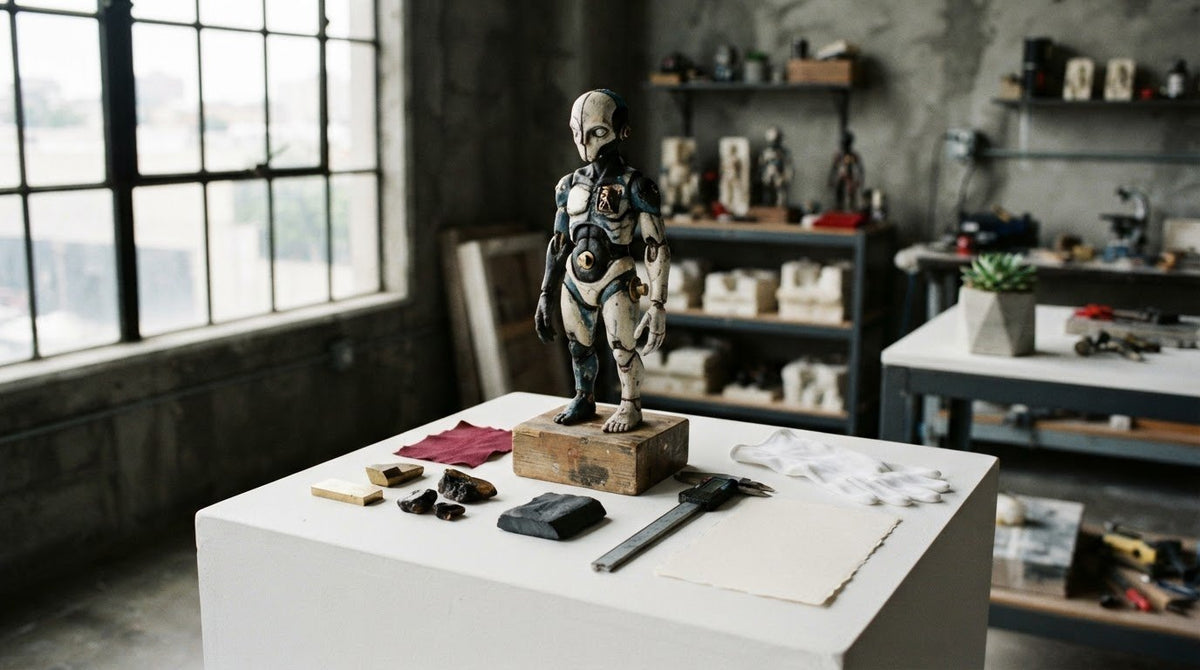
Collectible Art Toys in Limited Editions: Read the Object, Not the Hype
An edition number records a declared quantity. It does not establish authorship, material, or provenance. Listings for collectible art toys limited edition may emphasize release language while omitting the details that identify the object.
A production limit describes quantity, not the toy’s physical form or who created it. It also matters what the limit applies to: a character, a colorway, a material, or one release. Read the scope of the claim before treating it as a fact about the whole character or body of work.
This article explains what an edition statement establishes, what it leaves unanswered, and how to assess an art toy through its maker, construction, and records. Fringe’s Mylo, Nova, and Gutinke are original characters within the studio’s physical art practice. A release description is part of the record, not a description of the whole work.
Key Takeaways
- Read edition wording closely. The stated limit may apply to one version or release, not every form of the character.
- Assess collectible art toys limited edition through four points: authorship, the scope of the edition statement, the object’s physical details, and its documentation.
- Scarcity alone does not establish artistic importance, authenticity, or future value. Treat release language as one part of the record.
- Fringe’s original characters Mylo, Nova, and Gutinke place its collectible toys within an artist-led practice, rather than a licensed character line.
What Does “Limited Edition” Mean for Collectible Art Toys?
A limited edition has a stated boundary on the number produced. That boundary applies to the object or version named in the edition statement. It does not automatically apply to every release featuring the same character.
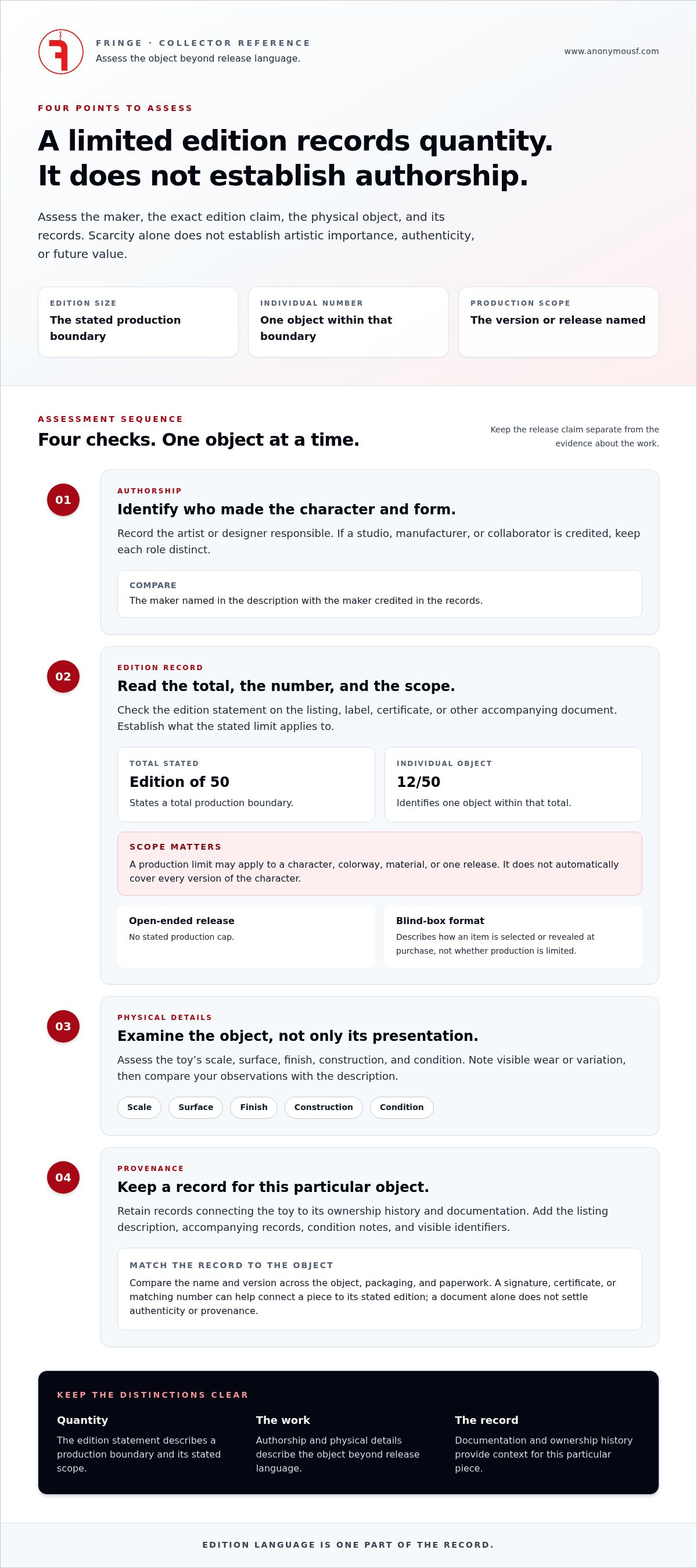
Edition information can appear on a listing, label, certificate, or other accompanying document. It may state the edition size, identify an individual piece, or do both. Read the notation precisely: “Edition of 50” states a total, while “12/50” identifies one object within that stated total. Neither notation establishes who made the work or whether the object matches its documentation.
Documentation is most useful when it corresponds to the object in front of you. A signature, certificate, or matching number can help connect a piece to its stated edition, but a document alone does not settle questions of authenticity or provenance. The Art toy overview provides broader context on the category, its origins, materials, and use of limited editions.
Limited availability is a production condition, not proof of artistic or historical significance.
Which details make an edition statement useful to a collector?
Separate the total from the individual number. An edition size states the production boundary; an individual number locates a particular object within that boundary. An open-ended release has no stated production cap. A blind-box format describes how an item is selected or revealed at purchase, not whether production is limited. These formats can overlap, but they are not interchangeable. When assessing collectible art toys limited edition, read the actual edition statement rather than inferring a cap from release language.
Does a Limited Edition Make an Art Toy Collectible? Assess the Object Beyond Scarcity
Assess the toy as an object with a maker, a physical presence, and a history. These details distinguish the work itself from a release whose appeal rests mainly on presentation.
Use four points to organize your assessment:
- Authorship: Identify the artist or designer responsible for the character and form. If a studio, manufacturer, or collaborator is also credited, record each role separately.
- Edition record: Compare the name and version described on the object, packaging, and accompanying paperwork. Differences in naming or version descriptions need to be resolved in your own record.
- Physical details: Examine scale, surface, finish, construction, and condition. Note visible wear or variation, then compare your observations with the description.
- Provenance: Keep records connecting this particular object to its ownership history and documentation. A coherent record preserves context when the toy changes hands.
Scarcity alone does not establish artistic importance, authenticity, or future value. Those judgments require evidence beyond promotional language.
What should collectors examine before judging rarity?
Start with attribution and physical identity. Check that the artist or studio named in the description corresponds to the maker credited in the records, and that the described version matches the object. Marketing language and launch timing can create urgency, but they do not identify who shaped the work or how it relates to an artist’s practice.
For collectible art toys limited edition, retain the listing description and any accompanying records. Add your own notes on condition, ownership, and visible identifiers. That file gives future comparisons a basis beyond memory or promotional copy.
How Original-Character Art Toys Put Authorship Before Release Hype
Fringe is an independent artist-owned studio creating physical pop art, including collectible toys featuring original characters. Mylo, Nova, and Gutinke were created within that practice. Their context is the artist’s work across forms, not a claim about an individual toy’s specifications.
That wider practice includes collectible toys, bronze sculptures, oil paintings, hybrids on paper, and limited-edition prints. The forms differ in medium, but they belong to the same artist-led body of physical work. The characters place the toys within Fringe’s practice rather than leaving each release to stand as an isolated product.
Where do Mylo, Nova, and Gutinke sit within Fringe’s work?
Mylo, Nova, and Gutinke are original characters within Fringe’s physical art practice. The Fringe collectible toys give those characters physical form, alongside the studio’s work in bronze, canvas, and paper.
For collectors, a character’s place within an artist’s broader work provides context beyond an individual object. The phrase collectible art toys limited edition may describe a release; the artist’s practice shows where its characters belong. These are distinct parts of the record.
Mylo, Nova, and Gutinke give Fringe’s physical art practice recognizable original characters. The toys belong to that practice.
Set a Standard That Outlasts the Release
Judge the next object by the attention it holds, not the urgency surrounding its release. With collectible art toys limited edition, a useful collecting practice begins before the next drop: record what draws you to an object, which claims are documented, and which details remain unanswered.
Keep those observations. Over time, they can show whether your collection is taking shape around a recurring visual language, an artist’s evolving ideas, or a calendar of launches. That distinction belongs to the collector, not the listing. A record of dates, descriptions, and your reasons for choosing each object gives your standard something concrete to test.
There is no need to turn every choice into a forecast. A collection can be deliberate without being a portfolio. Whether evaluating limited-run artist figures or exploring detailed scale models with hobby resources like Diecast Cartel, a standard built through close looking makes the next decision clearer.
Frequently Asked Questions
Is a limited-edition art toy automatically valuable?
No. A stated production cap does not guarantee demand or resale value for collectible art toys limited edition. Separate your interest in the object from predictions about its market. A low edition number describes scarcity; it cannot forecast future interest or establish why a particular toy matters as art.
How can I tell whether an art toy is genuinely limited edition?
Look for a production limit tied to the exact version being described. If a listing calls a toy “limited” but gives no quantity or object-specific record, the scope of the claim is unclear. Compare the version name, finish, and edition wording across the listing and accompanying documents. Release timing does not state how many were made.
Does a numbered art toy prove that it is authentic?
No. A number can identify a piece within a stated run, but a number on packaging or an object does not, by itself, prove who made it. Keep the number with its edition information and any records supplied with the toy. If the details do not correspond, record the discrepancy rather than treating the mark as conclusive.
What is the difference between a limited-edition art toy and a blind-box figure?
The terms describe different things. “Limited edition” refers to a stated production boundary; “blind box” means the buyer cannot identify the specific figure inside before opening the package. A blind-box figure could also belong to a limited run, but the packaging format does not establish a production cap. Read each claim separately.
View Fringe’s collectible toys alongside its bronze sculptures, oil paintings, hybrids on paper, and limited-edition prints.

Article by
Fringe

Read more
Buy Bronze Sculpture Online: A Collector’s Guide
A bronze label identifies a material category, not whether a particular work belongs in your collection. To buy bronze sculpture online, assess the object itself: photographs can flatten scale and ...
Read more
Original Pop Art Mixed Media: How to Read the Physical Work
“Original” and “mixed media” answer different questions. A pop art mixed media original is not defined by the label alone: originality describes the work’s status, while medium identifies its physi...
Read more
Leave a comment
This site is protected by hCaptcha and the hCaptcha Privacy Policy and Terms of Service apply.