
Verification of Limited Edition Art Prints: A Technical Guide
Not everyone understands the weight of a physical edition. That's rather the point. A reproduction mimics the image, but it fails to replicate the intent held within the paper and ink. Knowing how to verify limited edition art prints is the only way to separate a studio-direct work from a common reproduction. You likely recognize that a Certificate of Authenticity is only as strong as the studio that issued it.
This technical guide provides a precise framework for authentication through material facts and provenance. We will detail the physical markers of studio-direct work, including the 7.5 to 9.5 pH standard for archival paper and the specific meaning of abbreviations like AP or PP. You will gain a checklist for identifying authentic hybrids on paper and the documentation required for a secure investment. Understanding these technicalities ensures the quality of the work remains a settled matter.
Key Takeaways
- Identifying the handwritten fraction on the lower margin is the primary method for how to verify limited edition art prints.
- Establishing provenance requires a documented chain of ownership that begins at the artist's studio and matches the Certificate of Authenticity.
- Material integrity is confirmed by measuring paper weight in grams per square meter and verifying archival pH stability between 7.5 and 9.5.
- Magnification of the surface reveals the specific ink textures of silkscreen or lithography, separating studio editions from mass-market reproductions.
The Specification of the Numbered Edition
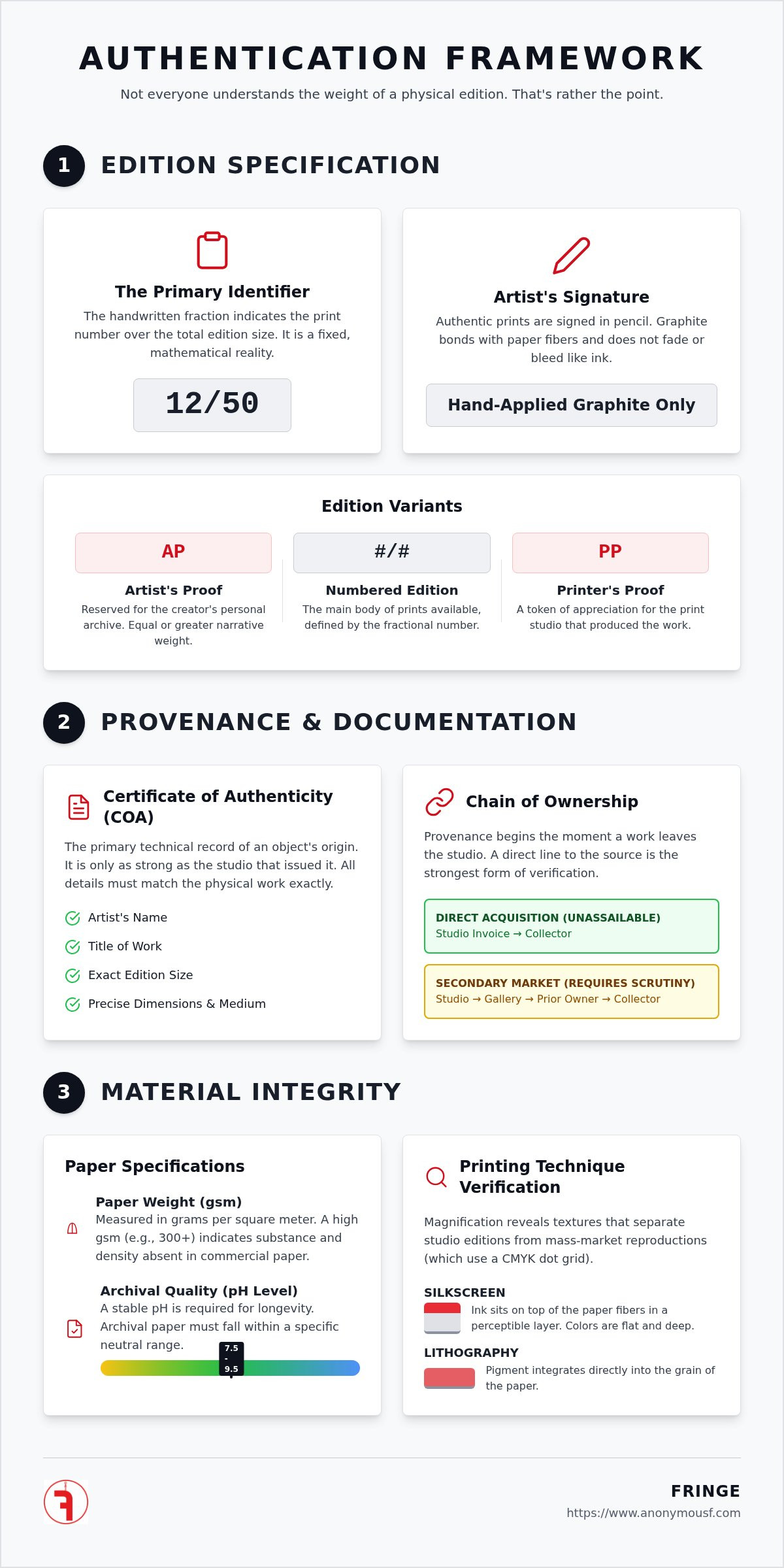
A limited edition print is defined by a fixed number of impressions produced from a single plate or screen. This count is a settled fact. It dictates the rarity of the multiple. Once the run is complete, the plate is retired or destroyed. The fraction at the bottom left indicates the specific print number over the total edition size. For instance, 12/50 signifies the twelfth print in a run of fifty. Beyond this standard numbering, certain identifiers like Artist Proofs (AP) and Printer’s Proofs (PP) exist. These are traditionally reserved for the creator and the studio. They carry equal or greater narrative weight because they represent the artist’s personal archives. Developing a technical understanding of limited editions allows a collector to discern the hierarchy of a release.
This numbering system provides the foundation for how to verify limited edition art prints. It establishes a finite quantity that cannot be altered. In the studio of Fringe, characters like Mylo and Nova appear across these editions, maintaining narrative consistency within a strictly controlled volume. The rarity is not an opinion. It is a mathematical reality documented on the paper itself. If the total edition size is not clearly stated, the work lacks the primary constraint that defines a fine art multiple.
Signatures and Hand-Marked Identifiers
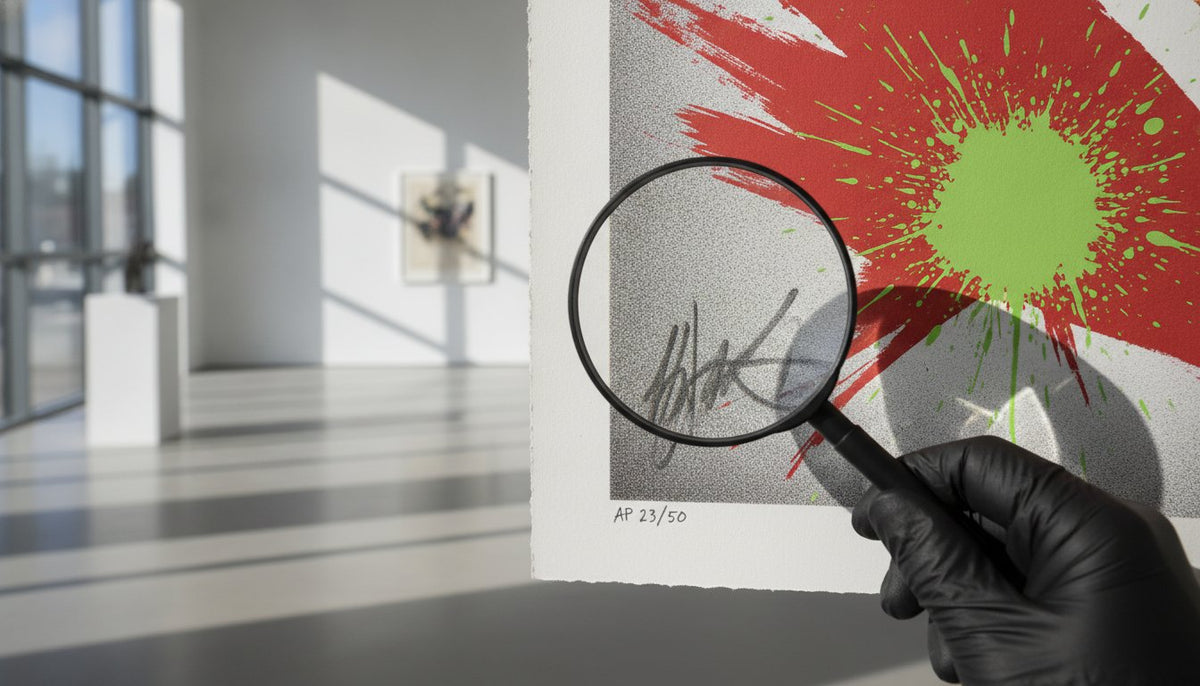
Authentic prints are signed in pencil. Graphite bonds with the paper fibers at a molecular level. It doesn't fade, crack, or bleed like chemical ink. The placement of the signature and edition number follows a specific studio logic, usually resting just below the image area. Hand-marking by the artist serves as a final verification of the physical object’s integrity. It's the moment the work is sanctioned as complete. The signature is not a decoration. It is a technical record of authorship that confirms the piece met the studio's standards. If the markings are printed rather than hand-applied, the work is a mass reproduction.
Verification Through Provenance and Documentation
Provenance is the documented history of an object’s ownership. It begins the moment a work leaves the studio and enters the world. A Certificate of Authenticity (COA) serves as the primary technical record of this transition. It must include the artist’s name, the title of the work, and the edition size. Any discrepancy in these fields renders the document obsolete. Specific dimensions and medium details on the COA must match the physical piece exactly. If the paper weight is recorded as 300 gsm but the physical sheet feels lighter, the provenance is compromised. This level of scrutiny aligns with expert guidance on collecting prints and protects the long-term value of the acquisition.
Invoices from an independent studio provide a direct, unassailable line of provenance. They bypass the ambiguity often found in secondary market transactions. When considering how to verify limited edition art prints, a receipt from the source is the most reliable evidence. It links the physical object to the studio's internal ledger. This connection ensures the narrative weight of the piece remains intact. It's a settled matter of record rather than a subjective claim. The authority of the studio ledger is the final word in authenticity.
The Role of the Artist’s Studio
Direct acquisition from the studio eliminates the need for third-party verification. Studio records maintain the definitive count of every character-based multiple, such as the Nova or Mylo editions. Fringe the Artist maintains these archives to protect the integrity of every physical art piece. This direct relationship between the collector and the creator preserves the soul of the object. It's a technical certainty that requires no outside validation. Collectors seeking this direct link often focus on the physical editions released directly from the source.
Material Integrity and Printing Techniques
Paper weight is measured in grams per square meter (gsm). It indicates the physical substance of the work. A 300 gsm sheet has a specific resistance and density that commercial paper lacks. For a paper to be considered archival quality, it must maintain a stable pH level between 7.5 and 9.5. This is a technical requirement for longevity. Silkscreen and lithography produce distinct textures that are visible under magnification. Silkscreen ink sits on top of the fibers in a perceptible layer. Lithography integrates pigment directly into the grain of the paper. These processes are fundamental to how to verify limited edition art prints.
Ink saturation and the absence of digital dot patterns distinguish fine art prints from commercial reproductions. A standard reproduction relies on a CMYK grid of tiny dots. Fine art multiples use flat, deep colors that are absolute. The edge of the paper is another technical marker. A deckled edge suggests a manual tearing process or a mold-made origin. A straight edge indicates a precision cut. Both are specific choices made during production. Preservation also leaves physical markers. Authentic prints are often housed behind UV-resistant glass that blocks 99% of ultraviolet wavelengths. This prevents the color fading typical of mass-produced items. Studios like Visibull Art and Design exemplify this focus on material integrity by producing original prints directly from tree cross-sections, where the organic texture serves as a primary marker of authenticity.
Hybrid Works and Mixed Media on Paper
Hybrid art on paper involves a convergence of mediums that can't be replicated by standard printing. These pieces exist between a print and an original painting. Texture and narrative weight define them. They carry the physical residue of the artist's process. Technical specifications on these multiples are documented in the studio news archives. Every piece is a physical art piece. The convergence of ink, graphite, and paint creates a depth that digital processes can't mimic. This technical specificity is the final marker of authenticity.
Securing the Integrity of the Multiple
Verification is a matter of physical evidence. The fraction on the paper and the pH level of the fibers are not suggestions. They are the technical boundaries of the work. A Certificate of Authenticity must match the 300 gsm weight and the studio-direct invoice to be considered valid. Understanding how to verify limited edition art prints allows the collector to move with confidence. Direct provenance from an independent studio ensures every physical art piece is documented within a fixed edition size. The narrative weight of characters like Mylo or Nova remains protected by these material facts. You can view the specification of Limited Edition Prints to see how these standards are applied. The object speaks for itself once the technical markers are confirmed.
Frequently Asked Questions
What is the difference between an Artist Proof and a numbered print?
An Artist Proof (AP) is a physical art piece pulled from the same production run as the numbered edition but reserved for the studio archive. While a numbered print of a character like Mylo follows a standard fraction like 12/50, an AP is marked with letters. Traditionally, these proofs account for 10% of the total edition size. Both versions share identical material facts.
How do I verify a signature on a limited edition print?
Verifying a signature requires inspecting the medium and its interaction with the paper fibers. Authentic signatures are applied in pencil because graphite leaves a slight sheen and doesn't bleed into the grain. It's usually placed at the bottom right. Comparing the stroke and pressure against verified studio records or direct invoices is the standard method for how to verify limited edition art prints.
Does a missing Certificate of Authenticity mean the print is fake?
A missing Certificate of Authenticity doesn't immediately invalidate a piece, but it complicates the chain of provenance. Documentation can still be established through original studio invoices or historical exhibition records. If the physical markers match the known edition specifications, the work remains authentic. However, a COA from an independent studio provides the most direct and documented evidence for any collector.
Why is pencil used for signing limited edition art prints?
Pencil is used because graphite is a stable, archival material that doesn't fade. Unlike chemical inks, it bonds with the paper fibers without causing acid degradation. This ensures the signature remains legible for the life of the work. It's a technical choice that prioritizes the longevity of the physical object. The presence of a pencil signature is a primary marker in how to verify limited edition art prints.

Article by
Fringe

Read more
Building a Cohesive Contemporary Art Collection: The Specification of Intent
Not every acquisition contributes to a legacy. That's rather the point. You've likely felt the quiet frustration of a room filled with significant pieces that refuse to speak to one another. It's t...
Read more
Investing in Original Character Art Toys: The Specification of Rarity
A plastic figure is a toy. A bronze Mylo is a record of human struggle. Not everyone understands the distinction. That is rather the point. You've likely noticed the exhaustion of an oversaturated ...
Read more
Leave a comment
This site is protected by hCaptcha and the hCaptcha Privacy Policy and Terms of Service apply.