
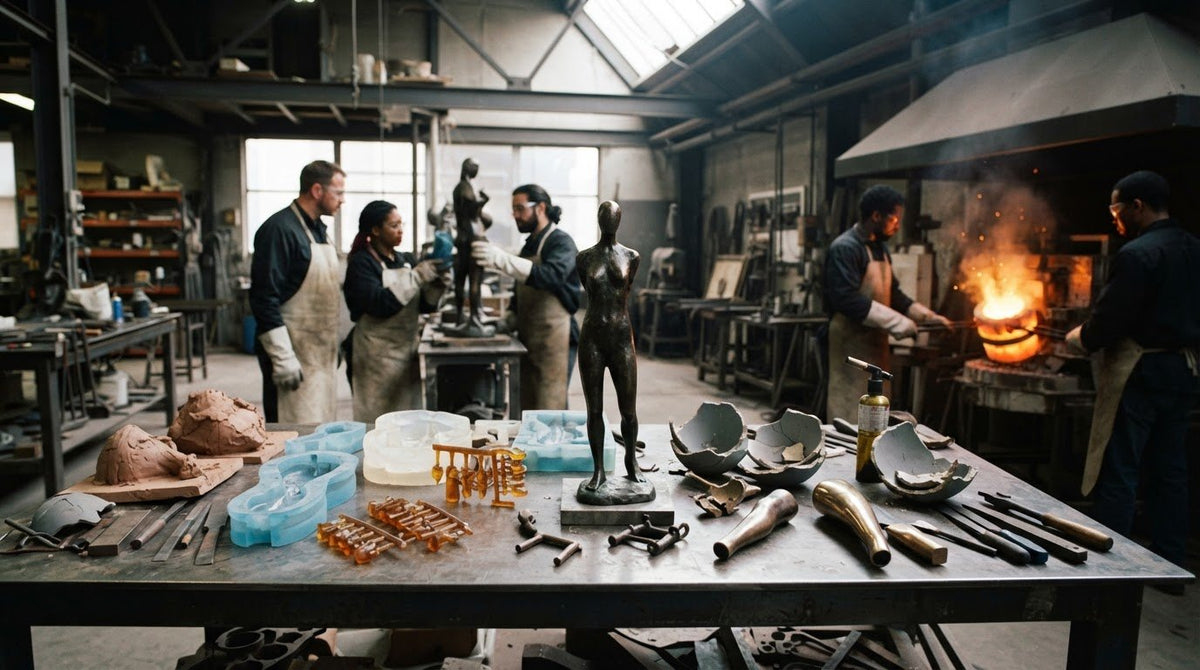
The Process of Creating a Bronze Sculpture: The Mechanics of Lost-Wax Casting
Bronze is never carved; it is an unforgiving metallurgical substitution of wax. A cast demands respect for physical law, yet most descriptions reduce the process of creating a bronze sculpture to romantic workshop lore. They quietly ignore high foundry failure rates, volatile shrinkage, and the harsh realities of molten metal. You already know that permanence in cast alloy cannot rely on digital shortcuts or sanitized craft tutorials.
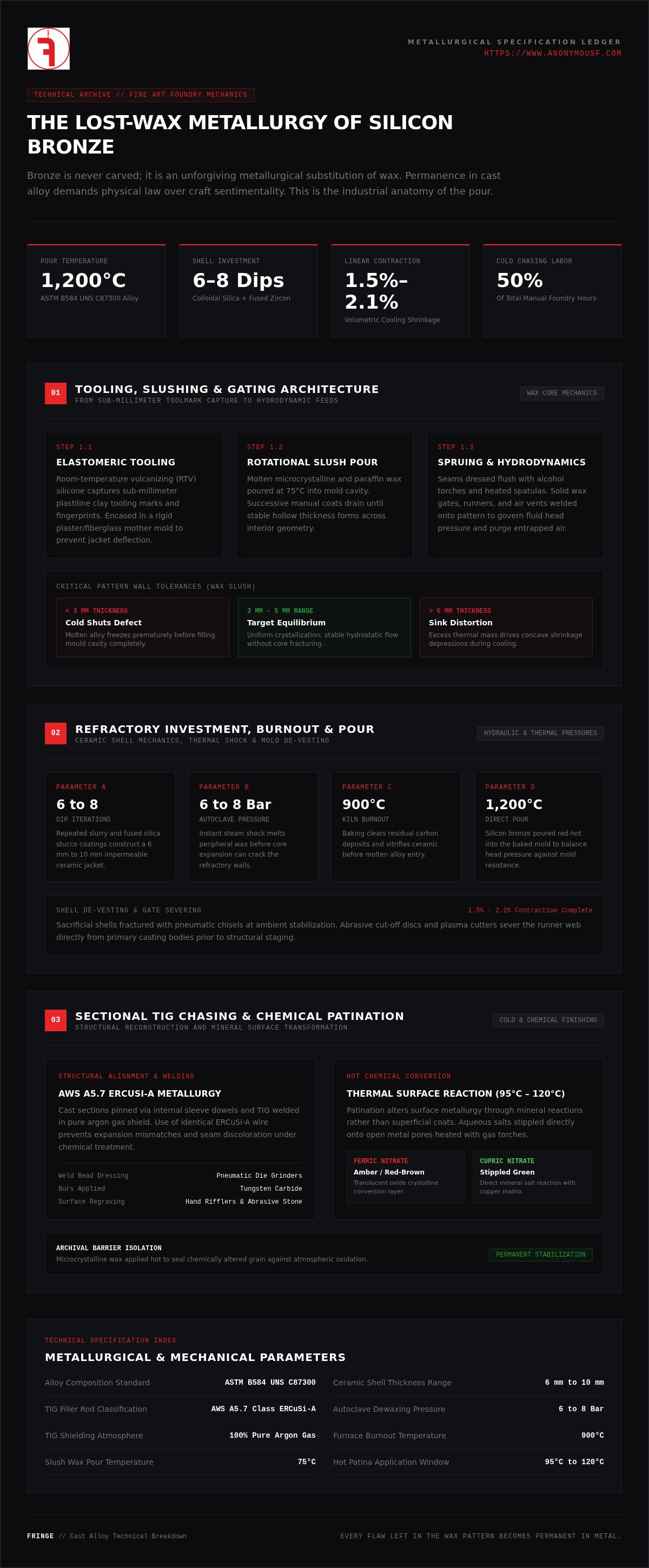
This technical breakdown deconstructs the twelve-stage lost-wax casting sequence, tracking the physical transformation from initial armature design to silicon bronze poured at 1,200°C. We examine the industrial realities of ceramic shell investment, ERCuSi-A seam chasing, and the mineral chemistry of hot patination so you can evaluate the physical finish and structural integrity of limited editions with complete authority.
Key Takeaways
- Elastomeric silicone tooling captures sub-millimeter tool marks from the original clay before hollow wax patterns establish uniform wall thickness to prevent shrinkage voids.
- Understanding the process of creating a bronze sculpture requires analyzing how colloidal silica slurries and refractory zircon stucco survive flash burnout and the hydrostatic pressure of molten alloy.
- Sectional casting demands precision TIG assembly using color-matched ERCuSi-A filler rod and manual cold chasing to erase weld seams without flattening original surface planes.
- A chemical patina alters surface metallurgy rather than applying paint, using aqueous mineral salts and microcrystalline sealing to ensure permanent resistance to atmospheric oxidation.
Stage One: Positive Modeling, Elastomeric Tooling, and Wax Replication
A clay sculpture is fragile; bronze makes it permanent. The industrial reality of the lost-wax casting process begins by destroying this original positive to produce a working duplicate. Technicians brush room-temperature vulcanizing (RTV) silicone over the sculpted plastiline clay, capturing sub-millimeter tool marks, fingerprints, and surface planes. A rigid plaster or fiberglass mother mold encases the flexible silicone jacket to prevent deflection under weight.
Foundry artisans pour molten microcrystalline and paraffin wax at 75°C into the assembled mold cavity. Workers slush the liquid wax manually, draining successive coats until a hollow wall thickness of 3 mm to 5 mm stabilizes. Wax walls exceeding 6 mm provoke sink distortion during cooling; walls below 3 mm cause cold shuts during the metal pour.
Pattern Wax Chasing and Gating Architecture
De-molded wax positives reveal parting lines and microscopic surface voids. Chasers dress these seams by hand with heated spatulas and alcohol torches, restoring the exact silhouette seen in editions like Quiet Boy.
Spruing follows. Artisans weld solid wax gates, runners, and air vents to the pattern to feed liquid alloy and expel gases. This gating system governs hydrodynamic flow, securing metallurgical density for a pop art bronze sculpture before shell dipping. In the process of creating a bronze sculpture, every flaw left in the wax pattern becomes permanent in metal.
Stage Two: Ceramic Shell Investment, Burnout, and the 1200°C Pour
Modern fine art foundries have abandoned historical plaster formulas for refractory ceramic shell investment. Artisans dip the gated wax assembly into an aqueous colloidal silica slurry, then coat it with fused silica stucco. Repeating this cycle six to eight times produces an impermeable refractory jacket 6 mm to 10 mm thick. Scholarly guidelines on the technical examination of bronze sculpture confirm that structural mold integrity dictates casting fidelity. Without controlled drying between layers, mold delamination destroys the investment.
Dewaxing requires sudden thermal shock. Autoclaves apply steam pressure at 6 to 8 bar, melting the exterior wax layer instantly so the core expands into void space rather than fracturing the ceramic. Kilns then bake the hollow shell at 900°C to eliminate residual carbon. Immediately following burnout, workers pour ASTM B584 UNS C87300 silicon bronze at 1,200°C into the red-hot shell, matching hydrostatic head pressure against mold resistance.
Solidification Dynamics and Shell De-Vesting
The poured alloy contracts at a linear rate of 1.5% to 2.1% during cooling. Once ambient temperature stabilizes, workers strike the sacrificial ceramic shell with pneumatic chisels, exposing raw metal webbed with sprues. Abrasive cut-off discs and plasma cutters sever the feeding gates from the primary casting. This physical transformation illustrates the industrial discipline behind the process of creating a bronze sculpture, yielding an editioned metal cast resistant to environmental decay. Collectors can evaluate these physical casting realities across the Quiet Boy bronze collection, where raw foundry output transitions into structural finishing.
Stage Three: Metal Chasing, Structural Assembly, and Chemical Patination
Bronze components leave the knockout floor as fractured puzzles. Large editions require multi-piece pours to guarantee wall consistency, demanding manual structural reconstruction. Foundry welders align cast sections using internal sleeve pins and TIG torches shielded with pure argon gas. They feed matching AWS A5.7 class ERCuSi-A silicon bronze wire into the seams. This identical metallurgy ensures unified expansion rates and color consistency across joints, avoiding the mismatched weld marks common in automated industrial work.
Chasers then grind the proud weld beads flush. They cut away excess metal using pneumatic die grinders with tungsten carbide burs, blending joints into adjacent planes. Hand rifflers and abrasive stones re-sculpt the fine textures captured during initial tooling. Historical surveys on the mechanics of the lost-wax method routinely skip this cold-chasing labor, yet it accounts for half the manual hours in the process of creating a bronze sculpture.
Surface Conversion and Archival Sealing
Patination is molecular transformation, never topical paint. The chaser torches the chased bronze to 95°C to 120°C, stippling liquid chemical solutions directly across the expanded metal grain:
- Ferric nitrate produces translucent red-brown to amber oxides.
- Cupric nitrate yields classic stippled greens and turquoise carbonates.
- Potassium polysulfide converts surface copper into dark baseline sulfides.
Once chemical reactions finish, artisans hand-rub microcrystalline paste wax into the warm metal at 70°C. This impermeable barrier halts further oxidation. The physical discipline behind works like the Quiet Boy bronze proves that structural permanence requires chemical precision at every stage.
Evaluating Physical Permanence in Limited Castings
True bronze casting tolerates no shortcuts. From the initial 3 mm wax positive to the 1,200°C pour, every stage demands metallurgical control. The process of creating a bronze sculpture isn't an artistic abstraction; it's a test of thermal limits, manual chasing, and chemical conversion. When you evaluate an edition, look for the evidence of human hands: erased weld seams that preserve original planes, crisp surface registration beneath the patina, and uniform wall thickness that guarantees structural stability.
Each edition of Quiet Boy reflects these foundry standards. Cast in industrial silicon bronze alloy, finished through manual foundry chasing, and sealed with archival microcrystalline wax, the work stands as permanent physical weight against digital ephemera. Review the metallurgical specifications of Quiet Boy cast in bronze.
Frequently Asked Questions
Why is hollow casting preferred over solid bronze for sculptures?
Solid bronze castings crack during cooling due to severe interior thermal mass and linear metal shrinkage reaching 2.1%. Casting hollow patterns with a controlled 3 mm to 5 mm wall thickness eliminates structural stress, minimizes interior shrink depressions, and maintains dimensional accuracy. It also prevents unmanageable dead weight on display plinths without compromising the physical tensile strength of the casting.
What is the primary alloy composition used in modern fine art bronze?
Fine art foundries rely on ASTM B584 UNS C87300 silicon bronze. The metallurgical formulation requires a minimum of 95.0% copper, 3.5% to 4.5% silicon, and 0.8% to 1.5% manganese. Silicon reduces liquid surface tension for crisp mold registration and resists outdoor atmospheric degradation. In the process of creating a bronze sculpture, this composition ensures predictable chemical responses during hot patination.
How does chemical patination differ from surface painting or powder coating?
Chemical patination alters surface metallurgy rather than depositing an adhesive topical coat. Applying aqueous mineral salts over bare metal heated to roughly 100°C converts the outer copper microns into stable metallic oxides and carbonates. Unlike standard industrial paint or powder coating, a true conversion patina cannot peel, flake, or delaminate because it forms an integral molecular bond with the bronze substrate.
How long does the lost-wax casting sequence take from clay to metal?
A production run typically requires eight to twelve weeks on the foundry floor. The process of creating a bronze sculpture cannot be accelerated without introducing structural flaws. Applying six to eight ceramic shell coats demands dedicated drying cycles between slurry dips, while manual argon TIG seam welding, pneumatic die grinding, hand chasing, and hot chemical patination require dozens of bench hours.

Article by
Fringe

Read more

How to Identify Emerging Talent in the Contemporary Art World
Not everyone understands the difference between a fleeting trend and a lasting legacy. That's rather the point. The secondary market is frequently a graveyard for works that lacked material integri...
Read more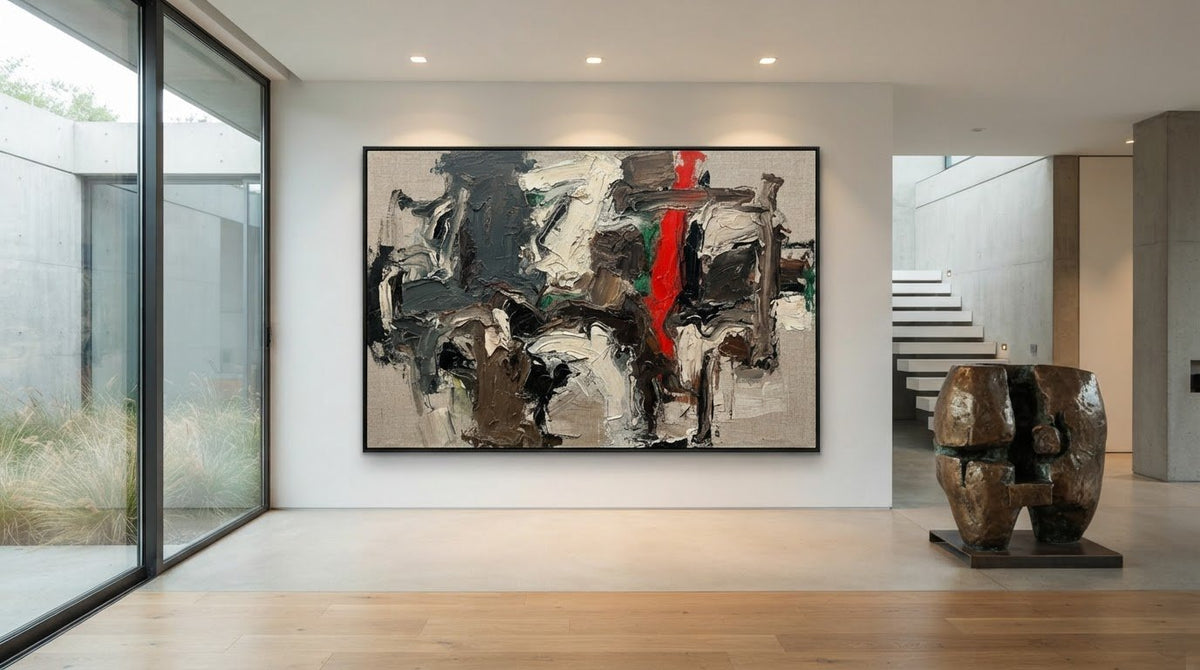
Statement Art for a Minimalist Home: The Collector Criteria
Most collectors assume a quiet room demands quiet work. That assumption explains why so many expansive walls dissolve into sterile vacancy. Selecting statement art for a minimalist home isn't an ex...
Read more
Leave a comment
This site is protected by hCaptcha and the hCaptcha Privacy Policy and Terms of Service apply.