

Original Art vs Print Investment Value: What Collectors Should Compare
An original isn’t automatically the stronger investment. The question of original art vs print investment value comes down to evidence about the specific work: an original is a distinct physical object, while a limited edition print is one impression in a defined edition. Neither format alone establishes what a later buyer will pay.
Compare provenance, condition, documentation, and relevant completed sales. If records for the artist or format are limited, treat the valuation as uncertain rather than assuming future growth.
Fringe creates oil paintings on canvas, bronze sculptures, hybrids on paper, limited edition prints, and character-based collectible toys. These are distinct physical formats, not promises of financial return. A sound decision weighs available evidence alongside what you want to own.
Key Takeaways
- Distinguish a unique original from a print by how each was made and whether it belongs to an edition.
- Assess provenance, condition, and documentation together; scarcity alone doesn’t establish value.
- Compare original art vs print investment value using resale evidence that matches the artist, format, edition, condition, and timing.
- Choose according to your collecting purpose and preferred format. Don’t assume appreciation or easy resale.
Original Art vs Print Investment Value: What Ownership Actually Means
An original is a distinct physical work. A print is made through a printmaking or reproduction process, and its edition identifies the impressions produced as part of that edition. Fringe creates oil paintings on canvas, bronze sculptures, hybrids on paper, and limited edition prints. Format describes the object; it does not forecast its resale price.
A unique work has no identical edition, but uniqueness alone doesn’t establish buyer demand. A numbered print has a defined edition, but its number doesn’t show what a later buyer will pay. For either format, the work’s details and relevant market evidence matter more than the label.
What makes an original different from an editioned print?
Edition size and numbering record a print’s place within an edition. They don’t establish future appreciation. The Art market overview describes a market shaped by factors beyond format, including demand and sale circumstances. For a closer look at original character art prints, see the print guide.
Keep three kinds of value distinct:
- Personal value: The significance the owner attaches to the work.
- Artistic value: Qualities such as medium, process, and the artist’s decisions.
- Financial value: What relevant resale records indicate buyers have paid for comparable works.
A work’s meaning to its owner isn’t evidence of a resale price. A limited edition doesn’t, by itself, document buyer demand. The original art vs print investment value comparison depends on the object and the available market evidence, not format alone.
Compare Original Art and Prints by the Evidence Behind Their Value
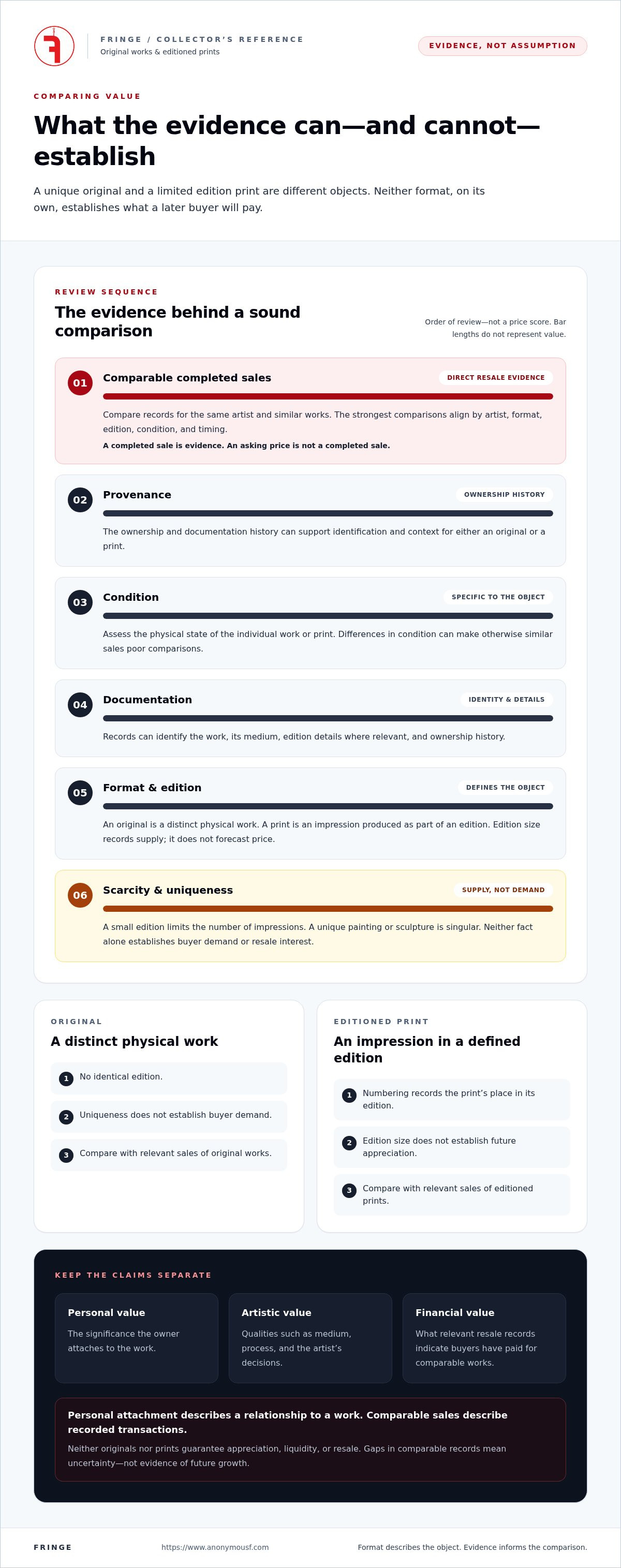
Compare like with like. The original art vs print investment value question becomes more useful when each claim is tied to evidence about a specific work, rather than a general assumption that one format is worth more.
Uniqueness: An original is a distinct physical work. A print belongs to an edition.
Edition size: This does not apply to a unique original. For a print, it describes the number of impressions in the edition, not a price forecast.
Provenance: For either format, provenance is the ownership and documentation history. A documented chain can support identification and context.
Condition: Assess the physical state of the individual work or print. Differences in condition can make otherwise similar sales poor comparisons.
Documentation: Records can identify the work, its medium, edition details where relevant, and ownership history.
Resale evidence: Compare sales for the same artist and similar works. Original works and editioned prints require separate comparisons.
How do scarcity, provenance, and resale evidence differ?
Scarcity is evidence about supply, not proof of future demand. A small print edition limits the number of impressions in that edition; it doesn’t show how many buyers want them. A unique oil painting or bronze sculpture is singular, but singularity alone doesn’t establish resale interest.
Comparable sales are most useful when artist, format, edition, condition, and timing align. Check that a record describes a completed sale, not merely an asking price. A sale of another print by the same artist may still be a weak comparison if its edition or condition differs. Factors in art valuation also include artist reputation, medium, and market evidence. For context on pop art original artwork, physical format remains distinct from investment certainty.
Choose Between an Original and a Print Without Assuming a Return
Start with the collecting purpose, not a prediction. The original art vs print investment value comparison is useful only when financial evidence is considered alongside the reasons you want to own the work.
Which format fits your collecting priorities?
- Purpose: Decide whether the work is primarily for personal collecting, financial consideration, or both.
- Format: Choose an original when the unique physical work is central to the decision. Consider a print when the image and its documented edition are what matter.
- Documentation: Review records that identify the work, its medium, edition details if applicable, and ownership history.
- Condition: Assess the specific object. Its condition affects how closely it can be compared with other works.
- Evidence: Look for relevant completed sales that align by artist, format, edition, condition, and timing. Treat gaps in comparable records as uncertainty, not as evidence of future growth.
Neither originals nor prints guarantee appreciation, liquidity, or resale. A unique work can have limited buyer demand; edition details don’t predict what a future buyer will pay for a print. Financial evidence informs a decision, but it cannot remove uncertainty.
Fringe’s physical formats include original oil paintings on canvas and limited edition prints, alongside bronze sculptures, hybrids on paper, and character-based collectible toys. The oil on canvas works show one form an original can take. A print offers a different relationship to an image through its edition. The choice rests on the object, the available evidence, and what you value in owning it.
Let the Evidence Inform the Work You Choose
Original art vs print investment value isn’t determined by uniqueness or edition status alone. Edition size records supply; provenance, condition, documentation, demand, and comparable sales provide further evidence. A comparable sale is relevant only when artist, format, edition, condition, and timing align.
Neither originals nor prints guarantee appreciation, liquidity, or resale. Personal attachment describes the owner’s relationship to a work; comparable sales describe recorded transactions. They are separate considerations.
Fringe creates original oil paintings, bronze sculptures, hybrids on paper, limited edition prints, and character-based collectible toys. Each is a distinct physical format. A comparison rests on the work’s documented details and relevant market evidence.
Frequently Asked Questions
Is original art a better investment than a print?
No. An original isn’t automatically a better investment than a print. Original art vs print investment value depends on evidence tied to the specific artist and work, including demand, condition, provenance, and relevant resale records. A unique object and an editioned print have different supply characteristics, but neither format alone establishes appreciation or how readily it may resell.
Can limited edition prints increase in value?
Yes, a limited edition print can increase in value, but its edition status doesn’t guarantee that outcome. Resale interest depends on factors such as demand for the artist and image, the print’s condition, provenance, and evidence from comparable sales. A limited edition defines a quantity; it doesn’t establish what buyers will pay later.
How does edition size affect a print’s investment value?
Edition size describes how many impressions belong to an edition, so it provides evidence about supply. A smaller edition may mean fewer impressions, but it doesn’t prove that demand exists or will grow. Compare edition size alongside the specific image, condition, documentation, and relevant resale evidence. Treat the number as context, not a price forecast.
What should collectors compare before buying an original or a print?
Compare your collecting purpose, preferred format, available documentation, condition, and relevant resale evidence. For prints, include edition details; for either format, review provenance and records that identify the work. Comparable sales are most useful when artist, format, edition where relevant, condition, and timing align. Neither an original nor a print guarantees appreciation, liquidity, or resale.
View Fringe’s oil on canvas works, limited edition prints, and character-based collectible toys.

Article by
Fringe

Read more

The Creative Process of an Oil Painter: Decisions, Revisions, and Material
An oil painting records decisions, not a fixed sequence. The creative process of an oil painter may begin with a reference, a memory, or a compositional problem, then change as forms, colors, and e...
Read more
Leave a comment
This site is protected by hCaptcha and the hCaptcha Privacy Policy and Terms of Service apply.