
Investing in Collectible Art Toys: A Specification of Value
Not everyone understands the distinction between a toy and an asset. That's rather the point. The saturation of mass-produced vinyl in 2026 has turned much of the secondary market into a landscape of diminishing returns. You've likely noticed that value often evaporates as quickly as the next social media trend. Investing in collectible art toys requires a move away from the "new" toward the permanent. Most browsers chase the hype. The serious collector analyzes the specification.
We agree that verifying provenance is becoming increasingly difficult in an overcrowded market. This assessment provides a technical look at rarity, material integrity, and the necessity of direct studio provenance. You'll understand why materials like bronze and stainless steel hold a narrative weight that common polymers cannot replicate. We will also examine how the 2026 Art Market Integrity Act proposals and new EU AML guidelines change the way high-value assets are acquired. This is a study of facts, not sentiment. We'll identify the metrics that determine whether a piece is a temporary distraction or a sovereign asset.
Key Takeaways
- Value is a function of supply. Fixed production runs establish the baseline for asset security in the 2026 market.
- Material permanence dictates long-term worth. Bronze and stainless steel offer a physical lifespan that common vinyl cannot match.
- Investing in collectible art toys requires prioritizing technical specifications over the volatility of social media trends.
- Direct studio provenance provides a verifiable chain of ownership. This eliminates the risks associated with secondary market saturation and counterfeit assets.
- Regulatory shifts, including the proposed Art Market Integrity Act, necessitate a rigorous approach to verifying the history of high-value character assets.
The Scarcity Principle in Investing in Collectible Art Toys
Investment in art is not a hobby for the sentimental. It is a study of supply. For those investing in collectible art toys, the primary metric of value is the fixed nature of the production run. Value does not exist in a vacuum; it is the result of a specific number of physical objects existing in a world of infinite demand. Mass production is the enemy of the collector. When an object is produced in the thousands, it ceases to be an asset and becomes a commodity. A limited edition of 50 carries a narrative weight that a run of 5,000 can never achieve. The Art toy market in 2026 demands this level of exclusivity.
Edition Sizes and Market Saturation
Low-volume releases ensure price stability on the secondary market. The Mylo character series is released in strictly controlled quantities, preventing the market saturation that plagues many vinyl collectibles. This scarcity is a technical specification. Edition size is the mathematical foundation of provenance. When the production run is closed, the supply is final. This finality is what secures the asset against the inflation of the "new." A collector is not buying a toy; they are acquiring a share of a finite series.
The Secondary Market and Exit Liquidity
Liquidity is found where the character narrative is already established. Characters like Nova and Gutinke represent established character assets with existing collector bases. These figures are not speculative experiments. They are proven entities. Direct acquisition from the Fringe studio ensures that the chain of ownership begins with total clarity. Provenance is the soul of the asset. It represents the shared memory between the creator and the holder. The object remains, indifferent to the volatility of the market.
Material Specifications: Assessing the Physical Object
The material of an object is its first truth. Most collectors ignore the chemical reality of their assets until the degradation begins. While vinyl is the standard for mass-market releases, it's a material that inevitably loses structural integrity over decades. Serious participation in investing in collectible art toys requires a focus on permanence. A physical asset must withstand the environment it inhabits. Bronze does not merely exist; it endures. The weight of a bronze sculpture provides a tactile confirmation of value that plastic cannot provide. It is the difference between a temporary trend and a historical record.
The Resilience of Bronze and Oil
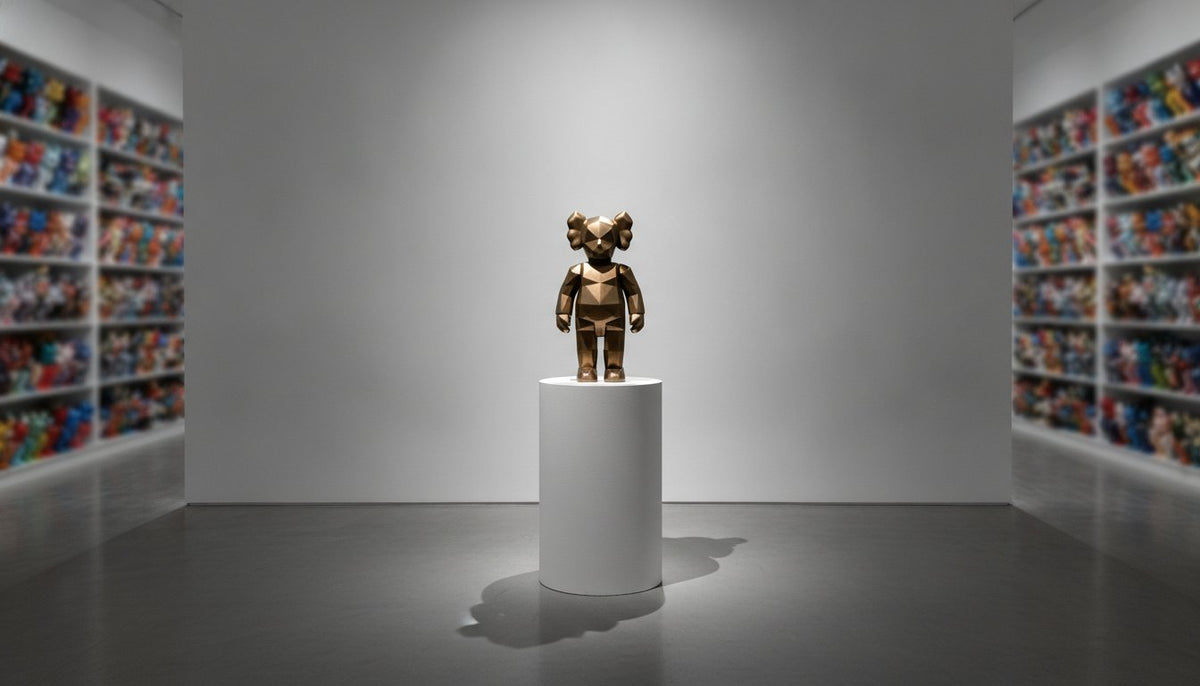
Bronze sculptures like the Quiet Boy are produced using traditional lost-wax casting methods. This process ensures that the character's narrative weight is matched by its physical density. Similarly, oil on canvas offers a texture and depth that digital or printed media cannot replicate. The Mylo collection utilizes these materials to bridge the gap between pop culture and high art. Following specific tips for buying collectible toys, a collector should prioritize materials that offer inherent longevity.
Comparing Asset Classes in Art Toys
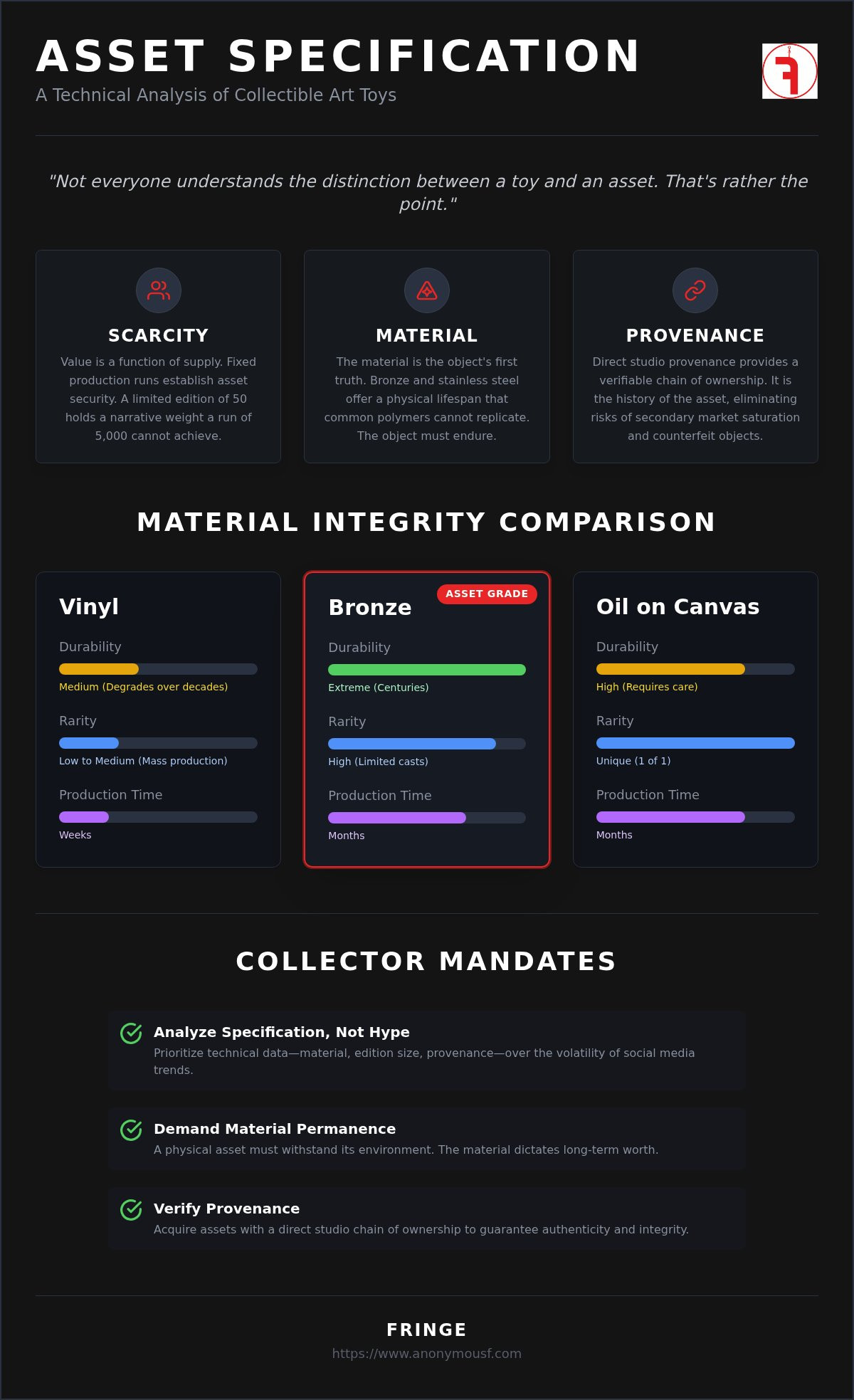
The choice of medium affects the rarity and the production timeline of the work. A pop art original artwork requires a physical presence that demands specific technical standards. The table below outlines the specifications of common art toy materials.
| Metric | Vinyl | Bronze | Oil on Canvas |
|---|---|---|---|
| Durability | Medium (Degrades) | Extreme (Centuries) | High (Requires Care) |
| Rarity | Low to Medium | High (Limited Casts) | Unique (1 of 1) |
| Production Time | Weeks | Months | Months |
The physical object remains the only true measure of an artist's intent. You might consider examining the bronze character studies available through the studio. The material is the message. The object is indifferent to the market; it simply remains.
Provenance and the Direct Studio Advantage
Provenance is the history of ownership; it is the soul of the asset. Most browsers assume a gallery receipt is enough. It isn't. When investing in collectible art toys, the chain of custody determines the integrity of the acquisition. Authenticity is a binary state; an object is either real or it is not. There is no middle ground in the verification of a physical asset. Direct acquisition from the Fringe studio eliminates the middleman, ensuring that the provenance remains unbroken from the creator to the collector. Every object is accompanied by a record of its origin. This record is the bridge between the artist’s intent and the collector’s possession.
Eliminating the Middleman
Gallery fees do not add value to the physical object. They are administrative costs that provide no structural or narrative weight to the piece. By removing these layers, the collector preserves capital while securing a direct link to the source. This model ensures that the history of the object is documented without the interference of third-party interpretation. The value remains within the object itself. It's a matter of technical clarity. The collector acts as a peer to the studio, sharing in the responsibility of the work's legacy.
Authentication Requirements for 2026
The 2026 art market requires rigorous documentation to withstand scrutiny. In the context of investing in collectible art toys, the studio seal acts as a final technical specification. Physical assets must possess specific markers of validity to maintain their standing in a collection.
- A certificate signed by the artist.
- A unique edition number recorded in the studio archive.
- A physical studio seal or stamp on the object.
Digital-only provenance, such as NFTs, is excluded from this physical asset class. A digital token cannot replicate the material integrity of oil on canvas or bronze. It lacks the tactile confirmation of existence. The object is a witness to the exchange between the studio and the collector. The studio remains indifferent to general trends or the volatility of digital speculation. The object exists regardless of the market's current fixation.
Securing the Permanent Asset
Not everyone understands that value is a calculation of physics and history. The 2026 market has exposed the fragility of mass-produced polymers and the volatility of digital speculation. Investing in collectible art toys requires a commitment to material permanence. A character asset must possess the structural density to outlast the trend that birthed it. Bronze and oil on canvas provide this density. These materials ensure that the narrative weight of the work is matched by its physical lifespan. The object doesn't need to explain itself; its weight does the work.
Direct studio provenance remains the only verifiable method of securing an asset's history. By eliminating the middleman, the collector maintains a direct link to the creator's intent. Limited edition runs establish the necessary scarcity to protect the investor's capital. Scarcity is final. The physical object is the final witness to the exchange between the artist and the observer. It's a quiet authority in a loud world.
The studio continues to produce works that prioritize the soul of the object over the noise of the gallery. The current specifications of The Mylo Collection are available for review. The asset remains. It's indifferent to the market's current fixation.
Frequently Asked Questions
Is art toy investment profitable in the long term?
Profit is a function of entry price, rarity, and material durability. Objects made of bronze or oil on canvas have historically maintained value better than mass-produced synthetics. Long term worth in investing in collectible art toys requires assets that resist environmental degradation. A physical object that survives the century is fundamentally more secure than a polymer that dissolves.
Which characters are best for investment?
The market favors established narratives over speculative trends. Characters like Mylo and Nova possess documented histories and strictly limited production runs, making them primary assets for serious collectors. These figures are not experiments in viral marketing. They are proven character assets with a fixed supply that protects the holder against market inflation.
How do I verify the provenance of a collectible toy?
Provenance is verified through direct studio records and physical certificates of authenticity. Acquisition directly from the artist studio is the most secure method to ensure an unbroken chain of ownership. Every transfer of the object must be recorded to maintain the asset's standing. An object without a verifiable origin is a liability rather than an investment.
What is the difference between a toy and a character sculpture?
The difference is found in the material composition and the edition size. A toy is a product of mass consumption, often manufactured in vinyl for a broad audience. A character sculpture is a limited physical art piece, often cast in bronze or painted in oil, intended for long term preservation. One is a purchase. The other is an acquisition.

Article by
Fringe

Read more
Investing in Collectible Art Toys: A Specification of Value
Not everyone understands the distinction between a toy and an asset. That's rather the point. The saturation of mass-produced vinyl in 2026 has turned much of the secondary market into a landscape ...
Read moreInvesting in Collectible Art Toys: A Specification of Value
Not everyone understands the distinction between a toy and an asset. That's rather the point. The saturation of mass-produced vinyl in 2026 has turned much of the secondary market into a landscape ...
Read more
Leave a comment
This site is protected by hCaptcha and the hCaptcha Privacy Policy and Terms of Service apply.