
Art Placement and Interior Design Rules: The Specification of the Object
An oil painting hung at an incorrect height isn't merely a visual oversight, it's a failure to respect the physical geometry of the object. Most collectors treat art as a secondary layer to furniture, yet the work demands its own structural logic. Adhering to art placement and interior design rules requires moving beyond decoration into the realm of conservation and narrative architecture. It's about recognizing that a bronze sculpture or a canvas has specific environmental needs that cannot be negotiated. Not everyone understands the weight of these requirements. That's rather the point.
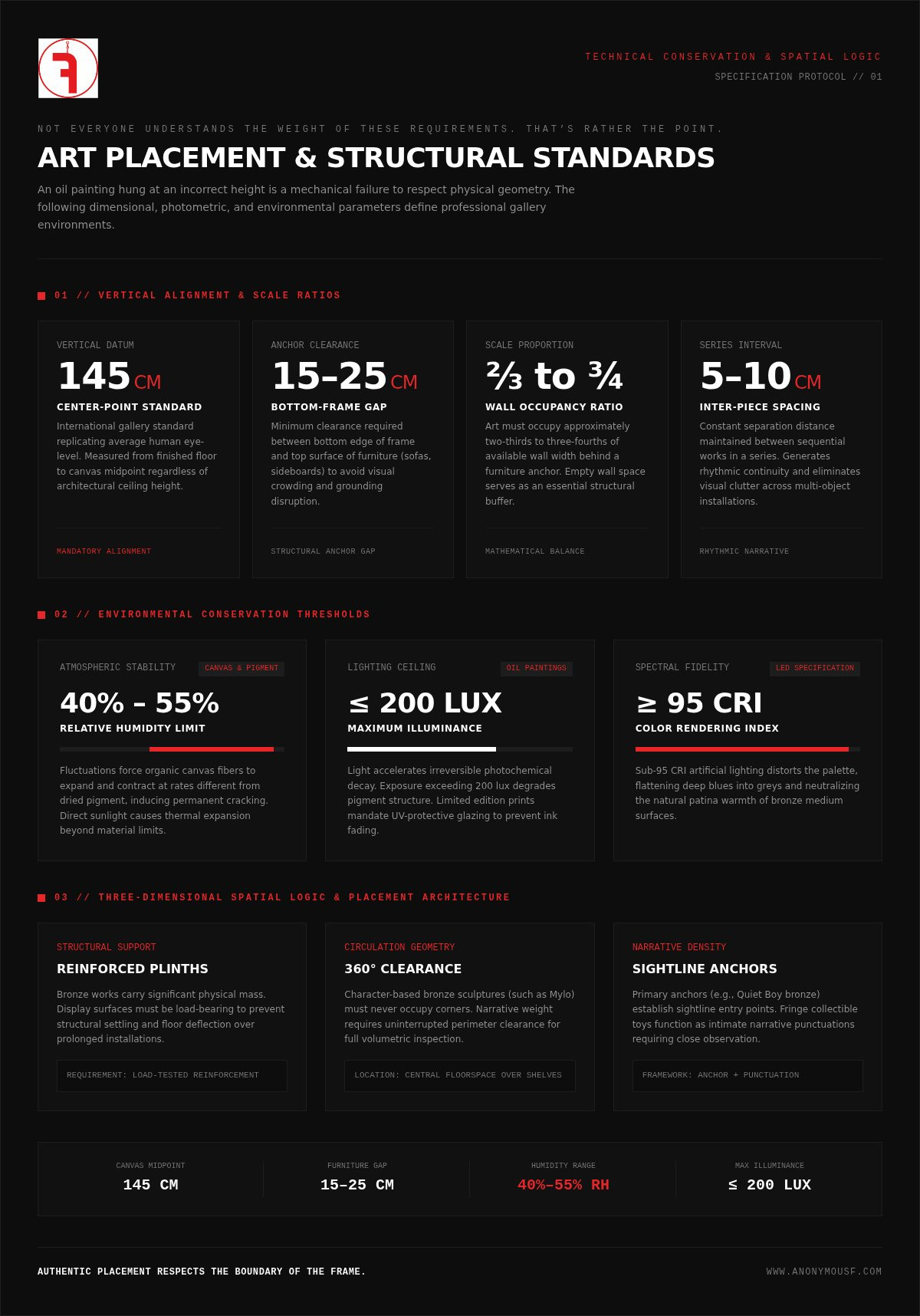
A room feels fragmented when a large-scale work dwarfs a delicate console. This analysis provides the factual standards for maintaining a gallery-level environment, including the 145-cm center-point rule and humidity thresholds for bronze. We will examine how to align scale, protect mediums from atmospheric decay, and build a cohesive narrative between objects.
Key Takeaways
- Position the center of an original oil on canvas exactly 145 centimetres from the floor to meet international gallery standards for vertical alignment.
- Apply art placement and interior design rules that maintain a humidity level between 40% and 55% to preserve the structural integrity of the canvas and pigment.
- Account for the physical weight of bronze sculptures by utilizing reinforced surfaces that allow for the 360-degree visibility required by character-based works.
- Maintain a precise distance of 5 to 10 centimetres between pieces in a series to establish a clear narrative and prevent visual clutter.
Vertical Alignment and the 145-Centimetre Standard
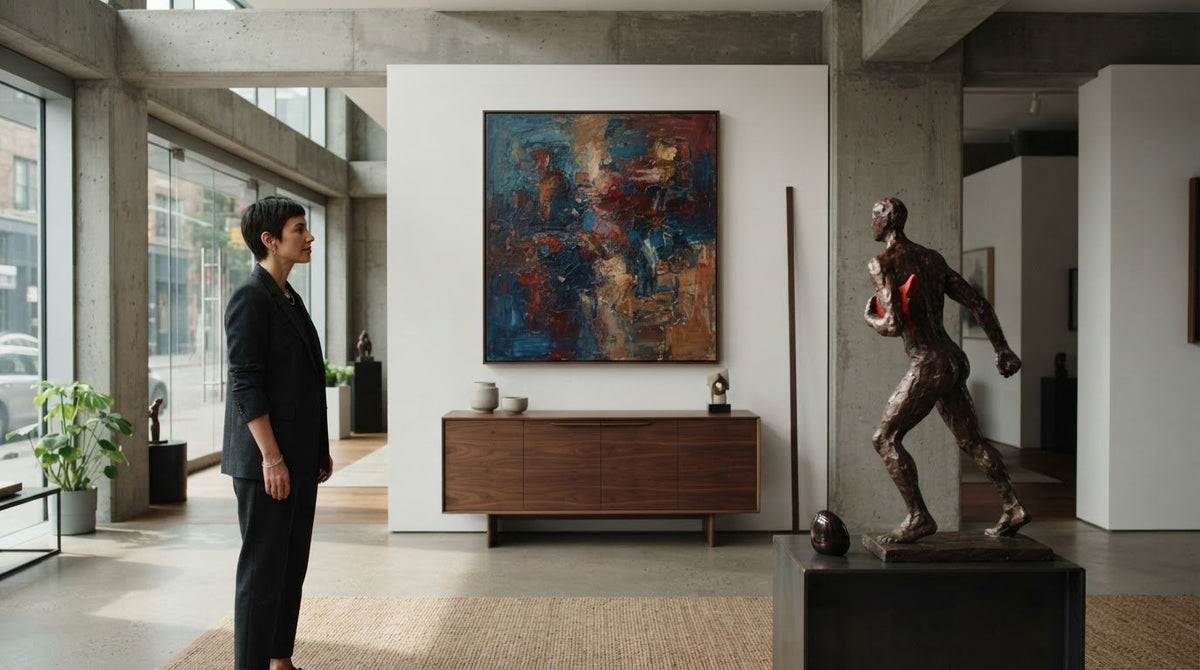
The vertical axis of a room is defined by the viewer's gaze. In professional settings, the center of an original oil on canvas must sit exactly 145 centimetres from the floor. This measurement isn't a suggestion. It replicates the average human eye level used in global gallery standards. It ensures the work remains the primary focus regardless of architectural height. The standard remains consistent across disparate ceiling heights. It grounds the viewer. When art sits at 145 centimetres, the textural depths of the paint are accessible. You don't look up at the work; you look into it. This is the difference between decoration and a gallery-standard display.
Adhering to art placement and interior design rules requires precision when interacting with furniture. Placement above a sideboard or sofa requires a minimum clearance of 15 to 25 centimetres from the bottom of the frame. This gap prevents the art from feeling crowded by the objects below it. Deviation from these numbers disrupts the architectural line of the room. Professional Interior design principles dictate that art functions as a structural anchor. If the piece is too high, it floats. If it's too low, it feels weighted by the floor. The 145-centimetre standard provides a fixed point of reference in a space of variables.
Scale Ratios Relative to Architectural Anchors
Scale is a matter of mathematical proportion. Art should occupy approximately two-thirds to three-fourths of the available wall width behind a furniture anchor. A single large-scale work provides a singular narrative focus that fragmented gallery walls often lack. In this context, empty space is a structural component of the placement. It isn't a void to be filled. It's a buffer that allows the object to exist without competition. The silence of the wall is as vital as the pigment on the canvas. Authentic placement respects the boundary of the frame.
Environmental Controls for Oil and Bronze Mediums
Placement is a matter of preservation. The physical integrity of an object depends on the stability of its surroundings. Art placement and interior design rules for original oil on canvas art dictate a relative humidity between 40% and 55%. When levels fluctuate, the organic fibers of the canvas expand and contract at a different rate than the dried pigment. This leads to irreversible cracking. It's a quiet, mechanical failure that occurs over years of neglect. Direct sunlight accelerates this process through thermal expansion. Heat forces the materials to stretch beyond their structural limits. This damage is permanent.
Bronze sculptures present a different set of requirements. These works possess a significant physical weight. They require reinforced plinths or load-bearing surfaces to prevent structural settling. Character-based sculptures, such as Mylo, require 360-degree clearance for narrative visibility. You shouldn't place a character in a corner. The narrative weight of the object depends on the viewer's ability to walk around it. This is why professional collectors prioritize floor space over shelf space for three-dimensional works. Understanding the physical specifications of the object ensures the work remains exactly as the artist intended.
Illuminance Levels and UV Mitigation
Light is both a necessity and a catalyst for decay. Illuminance for oil paintings should never exceed 200 lux to prevent pigment degradation. Limited edition art prints require UV-protective glazing. Without this barrier, the inks fade and the narrative clarity is lost. Artificial lighting must be restricted to LED fixtures with a Color Rendering Index (CRI) of 95 or higher. This ensures the spectrum remains true to the original work. Lower quality bulbs distort the emotional register of the color palette. They turn deep blues into greys and strip the warmth from the bronze.
Narrative Density in Multi-Object Displays
Proximity is not a substitute for composition. Placing multiple objects requires a primary anchor and secondary supports to guide the eye through the space. In a series, the distance between pieces must remain constant, typically between 5 and 10 centimetres. This creates a rhythmic pulse rather than a cluttered wall. Large bronze pieces, like Quiet Boy, belong at the entry point of a sightline. It functions as a structural greeting. Narrative placement assumes the reader understands the relationship between the characters. The work is a dialogue. Art placement and interior design rules dictate that this dialogue must remain legible. If the eye don't find a starting point, the collection fails.
The Spatial Logic of Collectible Figures
Small-scale Fringe collectable toys function as intimate narrative punctuations. They are the quiet details that reward close observation. Placing Nova or Gutinke figures in groups of three creates a stable visual triangle. This geometric arrangement provides a sense of permanence that a pair lacks. Proximity is a choice of density, not a necessity. The human truth is that objects require distance to be seen. Without negative space, the character is swallowed by the room. The void is what gives the physical medium its weight. It's a deliberate silence. A collector knows when to stop. The narrative weight of the object is preserved through this intentional isolation. Proximity suggests a shared history between the figures, while distance allows for individual reflection.
Preserving the Structural Narrative
Art placement is a technical requirement of the medium. It's not a decorative choice. The 145-centimetre standard and specific humidity controls ensure the work survives the environment. Bronze sculptures are cast in limited editions and require 360-degree clearance. Oil paintings are original character studies with textural depths that light can easily destroy. Hybrids on paper use archival materials that demand UV protection. These art placement and interior design rules are the difference between a collection and mere storage. The object carries the weight of the artist's intent. The physical specifications of Fringe original artwork are available for review. View the collection specifications. A space that respects these facts becomes a permanent home for the narrative. The work deserves this structural clarity.
Frequently Asked Questions
What is the 57-inch rule for art placement?
The 57-inch rule dictates that the center of an artwork sits exactly 145 centimetres from the floor. This measurement replicates the average human eye level used in global gallery standards to maintain a consistent visual horizon. Adhering to these art placement and interior design rules ensures that the textural depths of an oil on canvas remain accessible to the viewer without distortion.
How far apart should art be in a gallery wall?
Individual pieces in a series or gallery wall should maintain a constant distance of 5 to 10 centimetres. This spacing prevents visual clutter and allows the eye to distinguish between separate narratives. For character-based collectible toys or limited edition prints, a uniform gap creates a stable visual rhythm. Proximity is a deliberate choice of density that requires mathematical precision to avoid a fragmented appearance.
Can I hang an oil painting in direct sunlight?
Direct sunlight causes irreversible thermal expansion and pigment degradation in oil on canvas works. UV exposure breaks down the chemical bonds of the paint, leading to fading and structural cracking. Stable environments require light levels below 200 lux and a humidity range of 40% to 55%. Placing original pop art in a path of direct solar radiation is a failure of basic conservation standards.
Does sculpture placement affect the value of the art?
Placement directly impacts the long-term physical condition and narrative integrity of the work. Bronze sculptures require reinforced surfaces to support their physical weight and 360-degree clearance to preserve their character-based narrative. Damage from improper art placement and interior design rules, such as structural settling or surface corrosion, reduces the object to its material cost. Authenticity is maintained through strict adherence to these spatial requirements.

Article by
Fringe

Read more
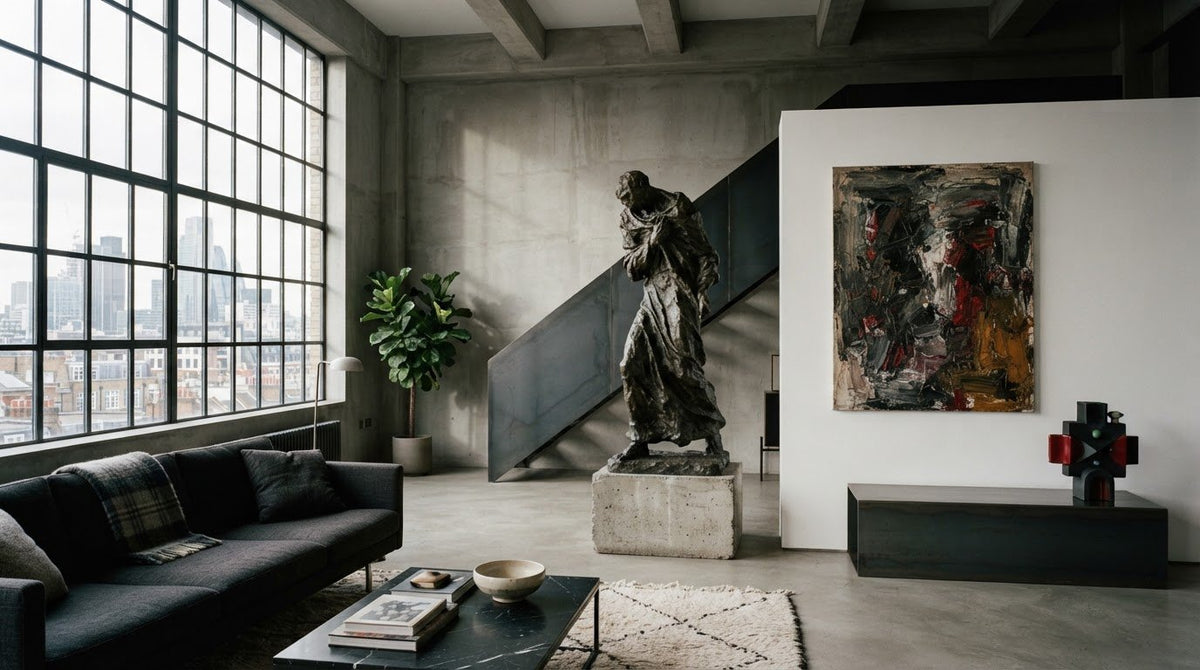
Conversation Starter Living Room Art: Collector's Guide
A living room shouldn't resemble a commercial furniture showroom. Matching canvas tones to upholstery is simple interior decoration, but acquiring genuine conversation starter art for living rooms ...
Read more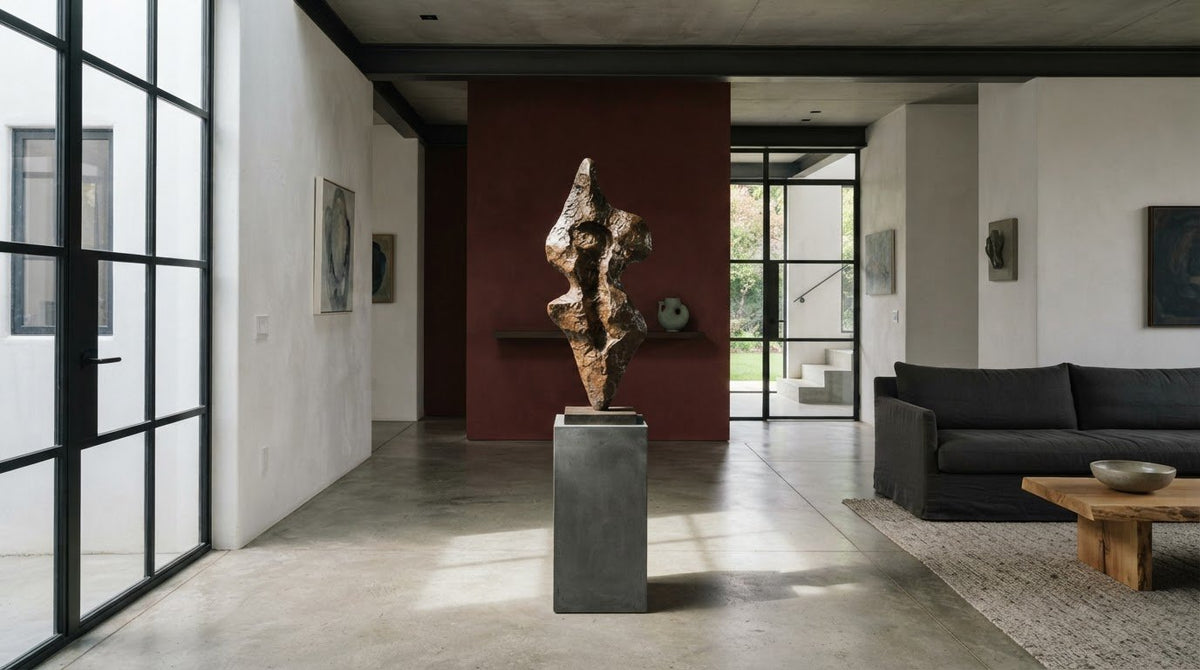
How to Display Sculptures in Your Home: A Practical Guide
Knowing how to display sculptures in your home starts with the object itself: its dimensions, shape, and the space it needs to remain visible. Placement depends on the sculpture and how people use ...
Read more
Leave a comment
This site is protected by hCaptcha and the hCaptcha Privacy Policy and Terms of Service apply.